
Numerical Reasoning Assessments: Elevate with numerical reasoning assessments
Discover proven strategies and real examples to ace numerical reasoning assessments in finance and consulting interviews.

So, you’ve encountered the term numerical reasoning assessment. Don't let the name intimidate you. This isn't your high school math final. Think of it less as a pure math test and more as a practical simulation of the kinds of data-driven challenges you'd face every day in a top-tier firm.
It’s designed to see how you think on your feet when presented with numbers, charts, and tables under a bit of pressure.
Decoding Numerical Reasoning Assessments

Ever wondered why consulting, finance, and major tech companies swear by these tests? It's simple: they're a surprisingly accurate predictor of on-the-job performance. These assessments have nothing to do with reciting complex formulas from a textbook. They measure your applied numeracy—how you actually use numbers in a business context.
An employer needs to know if you can glance at a sales chart and immediately spot the most important trend. Can you calculate a project's potential return on investment from a messy data table? Can you make a sound decision based on conflicting figures—all while the clock is ticking? That's what this is all about.
What These Tests Really Measure
At their core, numerical reasoning assessments are built to test a few crucial skills that are non-negotiable in any data-heavy role:
- Data Interpretation: How well can you actually read and understand the information staring back at you in graphs, charts, and tables?
- Logical Deduction: Can you take that numerical evidence and draw accurate conclusions from it?
- Problem-Solving Under Pressure: This is the big one. Can you perform calculations and analysis quickly and, most importantly, accurately within very tight time limits?
The goal is to shift your mindset from anxious to strategic. Success in these tests is far more about smart preparation and logical thinking than it is about advanced mathematical knowledge.
Why They Are a Crucial Hiring Tool
The fact that these tests are everywhere is no accident. The global market for numerical reasoning tests was valued at $799.2 million and is on track to hit $1,500 million by 2035. That’s a huge indicator of how vital they've become in high-stakes hiring, especially in industries like consulting and finance where sharp numerical acumen is the bedrock of everything from market analysis to strategic planning. If you're curious, you can explore more data on the NRT market growth to see just how fast this is expanding.
To give you a clearer picture of what to expect, the table below breaks down the most common formats you'll run into. Getting familiar with these structures is the first step toward building a winning preparation strategy.
Common Numerical Assessment Formats at a Glance
This table provides a quick summary of the formats and question types you're most likely to see. Recognizing them instantly will save you precious seconds during the test.
| Question Type | What It Measures | Common Format | Key Skill Required |
|---|---|---|---|
| Tables & Graphs | Ability to extract and compare data points | Line charts, bar graphs, pie charts, and data tables with multiple variables | Data extraction and trend spotting |
| Percentages & Ratios | Calculating relative values and proportional relationships | Word problems or table-based questions requiring margin, growth, or share calculations | Quick and accurate percentage calculations |
| Word Problems | Applying numeracy to a business scenario or case | A short paragraph describing a situation that requires a quantitative solution | Translating text into mathematical steps |
Ultimately, each of these formats is just a different lens through which an employer can assess the same core skills: your ability to think critically and work efficiently with numbers.
Solving The Most Common Question Types

Alright, let's get practical. You'll find that acing numerical reasoning assessments has less to do with high-level math and everything to do with spotting patterns. The same types of problems come up again and again.
Think of it like learning chess. Once you know how the pieces move—a knight’s L-shape versus a rook’s straight line—you start seeing the board differently and can think a few steps ahead. This section is all about learning those core "moves."
We’re going to break down the most common question types with clear, worked-out examples. The goal isn't just to find the answer, but to understand the logic behind it. This builds a reliable mental toolkit so you can confidently tackle any problem they throw at you.
Interpreting Tables and Graphs
The first and most frequent task you'll face is pulling information from tables and graphs. These questions are designed to see how quickly you can find the right data, spot trends, and run a few calculations based on what you see. It's a direct simulation of a real-world task, like analysing a sales dashboard.
Imagine you're handed a company's quarterly report. The table has columns for revenue, costs, and units sold by region. A typical question would be, "Which region had the highest profit margin in Q3?" This forces you to not only locate the right numbers but also apply the right formula (Profit Margin = (Revenue - Costs) / Revenue) while the clock is ticking.
The real skill here isn't complex arithmetic; it's data triage. You have to cut through the noise, pinpoint the exact figures you need, and perform the right two- or three-step calculation without getting sidetracked.
Example Problem: Table Analysis
| Product | Q1 Sales | Q2 Sales | Unit Price |
|---|---|---|---|
| Alpha | 1,500 | 1,800 | $50 |
| Beta | 2,200 | 2,000 | $75 |
| Gamma | 800 | 1,100 | $120 |
Question: What was the percentage increase in revenue for Product Gamma from Q1 to Q2?
- Find Q1 Revenue: 800 units * $120/unit = $96,000
- Find Q2 Revenue: 1,100 units * $120/unit = $132,000
- Calculate the Increase: $132,000 - $96,000 = $36,000
- Calculate Percentage Change: ($36,000 / $96,000) * 100 = 37.5%
The answer is a 37.5% increase. See how the data for Alpha and Beta was just there to distract you? Your first job is always to isolate what actually matters.
Mastering Percentages and Ratios
After data tables, a huge chunk of these tests comes down to percentages and ratios. This is where they test your grasp of proportional relationships—a critical skill for everything from market share analysis to growth forecasting.
You might be asked to find a percentage change, work out a ratio between two groups, or figure out what percentage of a whole something represents. Many questions are framed around business finance, so knowing how to read financial reports can give you a real edge here.
These concepts are usually wrapped in a short story or word problem, so setting up the calculation correctly is half the battle.
Example Problem: Ratios
Question: A company has 1,200 employees. The ratio of employees in the Sales department to the Operations department is 3:5. If these are the only two departments, how many employees are in the Operations department?
- Understand the Ratio: A 3:5 ratio means for every 3 people in Sales, there are 5 in Operations. This adds up to a total of 3 + 5 = 8 parts.
- Calculate the Value of One Part: The 1,200 total employees make up all 8 parts. So, one part equals 1,200 / 8 = 150 employees.
- Find the Operations Total: Since Operations accounts for 5 parts, you just multiply: 5 parts * 150 employees/part = 750 employees.
There are 750 employees in the Operations department.
Tackling Complex Word Problems
Finally, there are the word problems. These are the ultimate test of your applied numeracy because they bundle a multi-step puzzle into a business scenario. You have to translate a short story into a series of math operations. If you want a deeper dive into the format, check out our full guide on the numerical reasoning test.
These questions are really checking if you can:
- Pinpoint the actual question being asked.
- Pull out all the necessary numbers from the text.
- Figure out the right sequence of calculations.
- Execute those calculations without error.
They often combine percentages, ratios, and data interpretation all in one go.
Example Problem: Multi-Step Logic
Question: A retail store bought 200 jackets for $40 each. They sold 70% of the jackets at a 50% markup. The remaining jackets were sold at a 20% discount from the original cost. What was the store's total profit?
- Calculate Initial Cost: 200 jackets * $40/jacket = $8,000
- Analyze the First Batch:
- Number of jackets: 200 * 0.70 = 140 jackets
- Markup price: $40 * 1.50 = $60/jacket
- Revenue from first batch: 140 * $60 = $8,400
- Analyze the Second Batch (Remaining):
- Number of jackets: 200 - 140 = 60 jackets
- Discount price: $40 * 0.80 = $32/jacket
- Revenue from second batch: 60 * $32 = $1,920
- Calculate Total Revenue: $8,400 + $1,920 = $10,320
- Calculate Total Profit: $10,320 (Total Revenue) - $8,000 (Total Cost) = $2,320
The store's total profit was $2,320. The only way to solve these reliably is to break the problem down into small, manageable chunks.
Why Strong Numeracy Is a Top Predictor of Job Success
Ever wondered why top-tier consulting and finance firms lean so heavily on numerical reasoning tests? It’s not just a filter for people who don’t like math. It’s because strong numeracy—the ability to genuinely reason with and apply numbers—is one of the most reliable predictors of how well you'll perform in a data-heavy role.
Think about it. A consultant doesn’t just show a client a spreadsheet; they weave a compelling story from the data. An investment banker doesn't just crunch numbers; they use those calculations to weigh massive risks against potential rewards. The skills you’re asked to show in these assessments are a direct preview of your ability to handle these core tasks under real-world pressure.
From Test Problems to Real-World Decisions
The jump from a test question to a career-defining decision isn't as big as you might think. That timed problem asking you to interpret a chart? That’s a mini-simulation of analyzing market trends to steer a client’s strategy. When you're calculating percentage growth in a sample problem, you're mirroring the exact work needed to build a financial model for a potential acquisition.
These tests are designed to see if you can:
- Pinpoint Critical Information: Can you cut through the noise and find the figures that actually matter?
- Perform Accurate Analysis: Can you apply logic to draw the right conclusions from the numbers in front of you?
- Keep Your Cool Under Pressure: Can you make sound judgments when the clock is ticking and the stakes are high?
This is exactly why companies invest so much in these assessments. They need people who don't just see the numbers, but can truly think with them.
Fighting Bias and Making Sharper Judgments
In any strategic role, one of the most valuable skills is the ability to make objective, data-driven decisions. Strong numeracy is your best defense against the common cognitive biases that can trip up even the smartest people. When you’re comfortable with numbers, you're far less likely to be swayed by a gut feeling or a misleading narrative.
A candidate who can accurately dissect a complex dataset is more likely to challenge flawed assumptions, spot hidden risks, and make recommendations grounded in evidence, not just intuition. This is the very core of sound business acumen.
Research backs this up, showing that numerical reasoning is the strongest predictor of financial literacy, explaining about 23% of its variance. People with high numeracy skills have better number comprehension, are less influenced by how information is framed, and are less susceptible to emotional biases. This leads directly to better investment choices and risk assessments. You can dig into the connection between numeracy and financial decisions in the full study.
This skill is a cornerstone of a successful career where staying objective is everything. Building your numerical reasoning isn't just about passing a test—it's about developing the foundational thinking for a career built on sharp insights. As you prepare, remember that building your business acumen is the ultimate prize.
Managing Time Pressure and Avoiding Pitfalls
Let's be honest: the math in these tests is rarely the hardest part. The real challenge comes from two things: the ticking clock and the cleverly disguised traps waiting to trip you up. Acing a numerical reasoning test is less about being a math genius and more about keeping a cool head when the pressure is on.
Think of it like being a pilot in a storm. You have the skills to fly the plane, but can you follow your checklist and make smart decisions when the alarms are going off? The goal isn't to be a hero and answer every single question. It's to be smart, methodical, and walk away with the highest possible score in the time you're given.
The Art of Question Triage
Not all questions are worth the same amount of your time. Some are quick wins, designed to be solved in under a minute. Others are time-sinks, deliberately complex problems that can eat up precious minutes. The single most effective tactic here is question triage—a quick mental sort you perform the second you see a problem.
- Do Now: You see it, you get it. You're confident you can knock it out quickly. Do these first. They build momentum and put easy points in the bank.
- Do Later: This looks familiar, but you can tell it has a few steps or requires careful reading of the chart. Flag it. You’ll come back to these once you've cleared out all the low-hanging fruit.
- Do Last (or Guess): The question looks like a beast, or you're just not sure where to start. Don't get sucked in. This is a prime candidate for an educated guess at the very end. Burning five minutes on one monster question is a terrible trade when you could have solved three simpler ones.
This isn’t about running a frantic race against the clock; it’s about executing a controlled, strategic plan. You ensure no easy points are left behind.
The rule of thumb is simple: focus on your points-per-minute. It’s far better to correctly answer three one-minute questions than to spend four minutes wrestling with one tricky problem, even if you nail it in the end.
Spotting and Sidestepping Common Traps
Numerical tests are littered with little traps. They aren't there to test your math ability, but rather your attention to detail when you're in a hurry. Knowing what to look for is half the battle.
Here are the most common mistakes people make:
- Unit Mismatches: This is the classic. The question asks for a figure in millions, but the table is in thousands. Or the chart uses dollars and the question asks for euros. Always, always check your units before you start crunching numbers.
- Simple Calculation Errors: It's so easy to punch a wrong number into the calculator or mess up a simple addition when you're rushing. The best defense is estimation. Before you calculate, do a rough "back-of-the-envelope" version. If your final answer is miles away from your quick estimate, you've likely made a mistake somewhere.
- Misinterpreting the Question: Did they ask for profit or revenue? A percentage increase or the absolute difference? Once you have an answer, take two seconds to reread the very last part of the question to make sure you’ve actually answered what was asked.
In high-stakes fields like finance and consulting, skills like these are non-negotiable. Companies use numerical reasoning tests because they’re a direct proxy for how well someone can handle data under pressure—a core task in jobs like financial modeling. A simple mistake there could cost millions, which is why these tests are so crucial for pre-employment screening.
Boosting Your Speed with Mental Math
Your calculator is a tool, not a crutch. If you rely on it for every single step, you're going to lose valuable time. Sharpening your mental math skills is like giving your brain a turbo boost—everything just flows faster.
You don't need to be a human calculator, just focus on a few key shortcuts:
- Quick Percentage Calculations: Get comfortable finding 10% (just move the decimal one spot to the left), 5% (which is half of 10%), and 1% (move the decimal two spots). You can combine these to estimate almost anything. For example, 15% is just your 10% value plus your 5% value.
- Multiplying by 5: Don't type it in. It's faster to multiply the number by 10, then just cut it in half. (For example, 68 x 5 is the same as 680 / 2, which is 340).
- Rounding and Estimating: Before you even touch the calculator, round the numbers to something simple to get a feel for the answer. This not only helps you catch your own errors but can often let you eliminate a few of the multiple-choice options right away.
When you combine smart triage with a sharp eye for traps and faster mental math, you transform a stressful test into a problem-solving exercise you can control. That's what separates the good candidates from the ones who get the offer.
Your Four-Week Numerical Reasoning Training Plan
Let’s be honest: winging it is not a strategy. The fastest way to turn test-day anxiety into quiet confidence is with a solid plan. Instead of just doing random problems and hoping for the best, a deliberate week-by-week approach builds your skills systematically.
Think of this four-week plan as your roadmap. It’s designed to guide you from mastering the basic concepts all the way to full test-day readiness for your numerical reasoning assessments. Each week has a specific job, letting you lock in one layer of skills before moving on to the next.
Four-Week Numerical Reasoning Prep Schedule
This structured weekly plan is designed to build your skills, speed, and confidence for your upcoming numerical reasoning assessment.
| Week | Focus Area | Key Activities | Recommended Practice |
|---|---|---|---|
| Week 1 | Laying the Foundation | Solidify core math skills: percentages, ratios, and proportions. | 15-20 minutes of daily mental math drills. Work through untimed fundamental problem sets. |
| Week 2 | Mastering Question Types | Learn to decode tables, charts, and complex word problems quickly. | Targeted drills on specific formats (e.g., one day on charts, one on word problems). |
| Week 3 | Building Speed & Accuracy | Transition from knowing how to solve problems to solving them fast. | Introduce a stopwatch to all practice sessions. Aim to beat your previous times. |
| Week 4 | Simulating the Real Test | Replicate the full test experience to build endurance and refine strategy. | Take at least three full-length, timed mock exams under realistic conditions. |
Following this schedule helps you progress logically, making the whole process feel much more manageable and less overwhelming.
Week 1: Laying The Foundation
The goal this week is simple: get your core math skills rock-solid. You can't build a skyscraper on a shaky foundation, and you can't solve tricky business problems if you're stumbling over basic calculations. This isn't about learning brand-new math; it's about making the fundamentals absolutely second nature.
Your main focus should be on:
- Percentages: Get to the point where you can handle conversions, find percentage increases or decreases, and calculate parts of a whole without even thinking about it.
- Ratios and Proportions: Practice simplifying ratios and using them to distribute totals across different categories.
- Mental Arithmetic: Spend 15 minutes every single day on mental math drills. The goal is pure speed and accuracy with multiplication, division, addition, and subtraction.
This first week is all about sharpening your tools. When these core calculations feel effortless, you free up precious mental energy to tackle the more complex, analytical parts of the problems you'll face later on.
Week 2: Mastering Question Types
Okay, with the fundamentals locked in, it's time to apply them to actual test formats. This week is all about pattern recognition. You’re essentially learning the "language" of numerical reasoning tests by drilling the most common question types you’ll see.
Target your practice like this:
- Tables and Charts: Spend a couple of days focused only on pulling data from tables, bar charts, line graphs, and pie charts.
- Word Problems: Dedicate the next two days to the art of translating business scenarios into clean mathematical equations. The trick is to break down the wordy problems step-by-step.
- Mixed Drills: For the rest of the week, use practice sets that mix everything together. This gets you used to shifting gears quickly from one format to another, just like on the real test.
A huge part of success is managing the clock. This simple workflow is a great mental model to start building now.
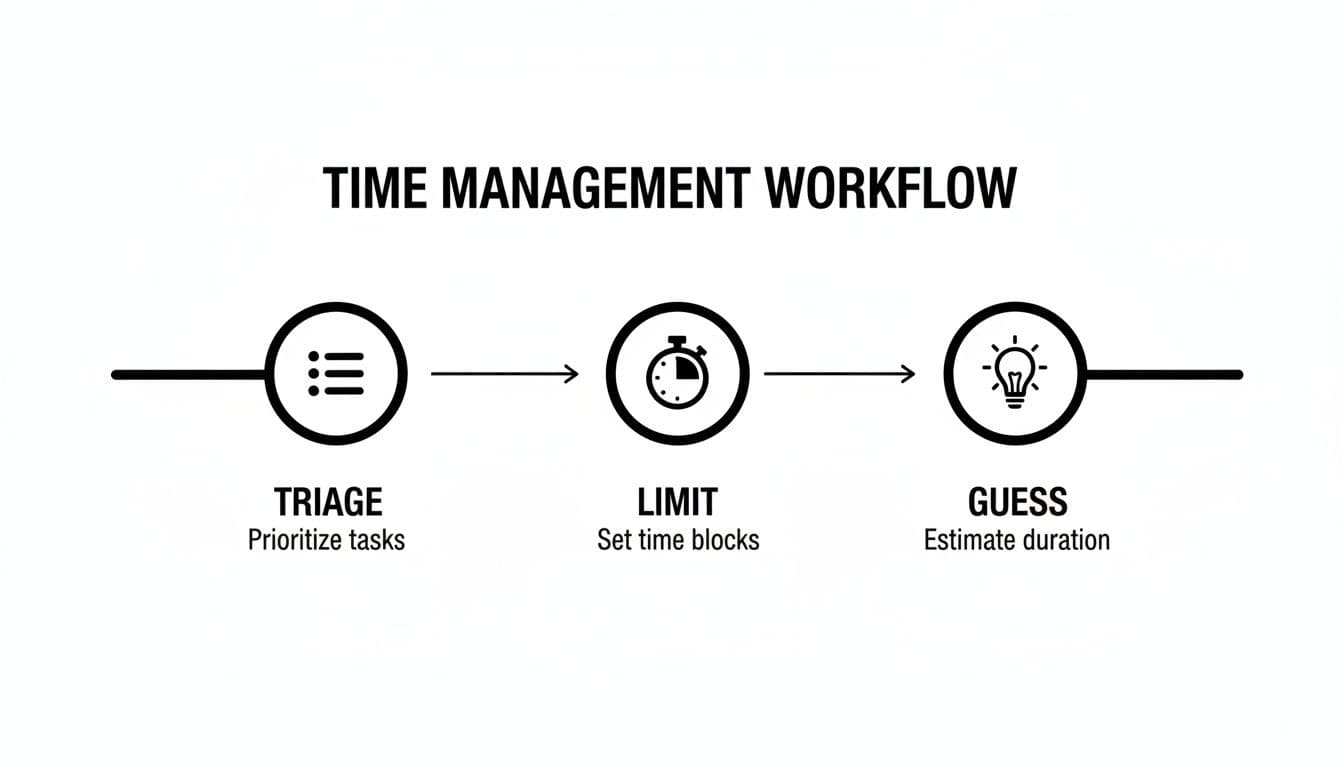
This process—quickly triaging questions, limiting time on any single problem, and knowing when to make an educated guess—is what separates a good score from a great one.
Week 3: Building Speed And Accuracy
You now have a solid grasp of the question formats. The mission this week is to start performing under pressure. It's all about the clock. Your goal is to slash your time-per-question without letting your accuracy slip.
This is where strict, timed practice becomes non-negotiable.
Start using a stopwatch for every practice set. Aim to finish a set of 20 questions within the typical time limit, which is often around 20-25 minutes. After each timed drill, review your results. Figure out exactly where you lost time and which mistakes were just from rushing.
For more powerful strategies on boosting your speed and sidestepping common errors, check out our in-depth guide to numerical reasoning test practice.
Week 4: Simulating The Real Test
It’s go-time. This final week is where you put it all together. The entire focus is on building mental endurance and polishing your test-day strategy by taking full-length mock exams. This is your dress rehearsal.
- Take Full-Length Mock Tests: Schedule at least three complete, timed mock assessments. Find a quiet spot where you won't be interrupted and treat it like the real thing.
- Analyze Your Performance: After each test, do a deep dive into your results. Don't just look at what you got wrong; figure out why. Did you misread the question? Make a simple calculation error? Run out of time?
- Refine Your Strategy: Use that analysis to fine-tune your approach. Practice your question-triage strategy, identify any final weak spots for some last-minute drills, and get your pacing down to a science.
By the end of this week, the real test should feel familiar, not frightening. You'll have built the skills, the speed, and the strategic confidence you need to walk in and perform at your absolute best.
How to Gain a Competitive Edge in Your Prep
Just grinding through practice tests will only get you so far. If you really want to stand out from the pack, you need to stop just solving problems and start training like an athlete. That means identifying your weak spots, drilling them until they're second nature, and practicing under real-world pressure.
Think about it like this: a concert pianist doesn't just play the same full sonata over and over. They find the most difficult passages and isolate them, practicing those few bars relentlessly. Your approach to numerical reasoning tests should be just as focused.
Pinpoint and Fix Your Weak Spots
The first step to effective prep is an honest look in the mirror. Are you lightning-fast with percentages but get bogged down interpreting dense bar charts? Maybe you crush market sizing questions but always stumble on profitability calculations. This is where targeted drills become your best friend.
Instead of taking one generic test after another, a platform that lets you isolate specific skills is a game-changer. This approach is the difference between wandering aimlessly around a gym and having a personal trainer build a custom workout for you. You can turn your weaknesses into strengths, one skill at a time.
For instance, the Soreno platform lets you zero in on specific numerical skills with guided practice sessions.
As you can see, you can choose specific drills like "Charts" to hammer away at the exact areas that give you trouble.
Build Resilience with Realistic Simulations
Knowing how to solve a problem is one thing. Doing it with a clock ticking down and a recruiter watching your every move is a completely different ballgame. The pressure of a real test can make even simple math feel like rocket science.
This is why simulating that interview environment is so critical. AI-powered mock interviews are perfect for this, creating the pressure of being watched and having to explain your logic on the fly—without needing to schedule time with a real person.
Practicing this way helps you:
- Practice thinking out loud: Recruiters want to hear your thought process, not just see the right answer.
- Manage test-day nerves: The more you expose yourself to pressure in practice, the calmer you'll be when it really counts.
- Refine your pacing: Simulations help you get a feel for the rhythm of the test, so you learn to allocate your time wisely.
For an extra edge on those head-scratcher problems, you can use an AI Math Solver during your practice to check your work or see a different way to tackle the solution.
Get Objective Feedback to Guide Your Growth
How do you actually know you're getting better? A vague feeling of improvement isn't going to cut it. You need objective feedback that scores you on the same criteria a real evaluator uses.
A complete training ecosystem gives you a clear advantage. Unlimited practice, targeted feedback, and realistic simulations work together to build not just skill, but unshakable confidence.
This is where rubric-based feedback is the gold standard. Tools like Soreno can analyze your performance and give you hard scores for things like numeracy, the structure of your logic, and even how well you communicate. This data shows you exactly where you stand and what to work on next, turning your prep from a guessing game into a clear, actionable plan. That's the edge that lands you the offer.
Got Questions? We’ve Got Answers.
Even the most well-prepared candidates have a few lingering questions as they head into their numerical reasoning assessments. Let's tackle some of the most common ones that pop up about test rules, scores, and how these evaluations really differ from the math tests you took in school.
Can I Use a Calculator?
This is a big one, and the short answer is: it depends. The policy is set by the employer or the company administering the test. Some will give you a simple on-screen calculator, while others ban them entirely to see how sharp your mental math skills are.
The golden rule is to always read the instructions carefully before you start. Your best bet is to prepare for both situations. Get comfortable doing quick calculations in your head, but also make sure you’re quick and accurate with a basic calculator for the trickier stuff.
What’s Considered a “Good” Score?
There’s no single magic number here. Most companies use percentile ranks, meaning your score is all about how you stack up against other people who took the same test. If you score in the 75th percentile, for instance, you did better than 75% of the people in that comparison group.
For the really competitive jobs at top consulting firms or investment banks, you're often expected to be in the 80th or 90th percentile. It’s not just about getting the answers right; it's about getting them right faster than the competition to land in that top tier.
How Is This Different From a Regular Math Test?
They might both involve numbers, but they’re playing a totally different game. School math tests are all about proving you know specific formulas and theories. They test what you know.
Numerical reasoning assessments, on the other hand, are about applying that knowledge. They test your ability to take basic math and use it to figure out what’s going on in a business scenario—interpreting a chart, spotting a trend in a table, or solving a practical problem. It's less about complex algebra and more about your analytical horsepower and ability to draw smart conclusions from data.
Ready to turn all this prep into a real competitive edge? Soreno offers the guided drills, realistic AI mock interviews, and detailed, rubric-based feedback you need to walk into your assessment with confidence. Start your free trial and see the difference at https://soreno.ai.