
Case Interview Prep: Master the case interview prep skills and land offers
Discover practical strategies for case interview prep, build a solid framework, and sharpen the business intuition to land your dream offer.

Cracking a case interview isn't about magic; it's about having a smart, repeatable system. The best candidates don't just do endless cases—they diagnose their weaknesses, build core consulting skills from the ground up, and then ramp up the pressure with timed drills and realistic mock interviews. That's how you get ready for the big leagues.
Your Realistic Path to Case Interview Readiness

The internet is overflowing with conflicting advice, a million frameworks, and the scary suggestion that you need to practice 50+ cases. It's overwhelming. Let's cut through the noise with a practical roadmap that turns that uncertainty into structured confidence. We’re moving past generic tips to focus on what actually moves the needle.
Your journey shouldn’t start with memorizing frameworks. It starts with a brutally honest self-assessment. Figure out where you really struggle. Is it creating a MECE (Mutually Exclusive, Collectively Exhaustive) structure when the clock is ticking? Do the numbers make your mind go blank? Or do the “tell me about a time” questions catch you off guard? Nailing down these sticking points lets you build a prep plan that’s actually for you.
The Core Pillars of Case Interview Prep
Every successful case interview performance is built on a foundation of specific, masterable skills. Before diving into full-blown cases, it's critical to isolate and strengthen each of these areas. Think of it like a musician practicing scales before playing a symphony. The table below outlines the non-negotiable pillars of your prep.
| Skill Pillar | Why It Matters | Key Development Activities |
|---|---|---|
| Structuring & MECE Logic | This is the bedrock of problem-solving. It shows you can break down a messy, ambiguous problem into clean, manageable pieces. | Practice creating issue trees for various prompts. Review and refine your structures against expert examples. |
| Problem-Solving Frameworks | Frameworks (like Profitability, Market Entry) are your starting toolkits, not rigid scripts. They help you organize your initial attack on a problem. | Learn the classic frameworks, but more importantly, understand the business logic behind them so you can adapt them on the fly. |
| Mental Math & Quants | Interviewers need to see you're comfortable with numbers. Speed and accuracy here build credibility and free up mental space for bigger insights. | Use dedicated math drills for percentages, growth rates, and large number calculations. Practice "sanity checking" your answers. |
| Chart Interpretation | Cases are filled with data presented in charts and graphs. You must be able to quickly extract the key "so what" from the data. | Find business-oriented charts and practice summarizing the main takeaway and its implications in under 30 seconds. |
| Business Intuition | This is your feel for how businesses work. It helps you ask smarter questions and generate recommendations that make real-world sense. | Read business news (e.g., The Wall Street Journal, The Economist). Think critically about why companies succeed or fail. |
| Behavioral & Fit Prep | Firms hire people, not just analytical machines. Your stories must demonstrate leadership, impact, and a collaborative spirit. | Prepare stories using the STAR method. Align your personal narrative with the specific values of the firm you're targeting. |
Focusing on these pillars individually ensures you're not just practicing your mistakes in full case mocks. Instead, you're building a reliable skill set that you can depend on under pressure.
From Isolated Drills to Full Mocks
A great prep schedule doesn't just throw you in the deep end. It ramps up intensity over time.
Start with targeted exercises. Dedicate sessions just to structuring random prompts or running mental math drills. As your confidence and muscle memory improve, you can move on to running full cases solo, timing yourself to get used to the pace.
Only then should you dive into full mock interviews with partners, alumni, or an AI interviewer like Soreno. This gradual progression builds skills methodically and reduces the cognitive load during a real interview, so you can focus on what matters: delivering sharp, impressive insights.
The single biggest mistake I see is candidates jumping straight into full case practice. They end up reinforcing bad habits from day one. A methodical, skill-by-skill approach is always faster in the long run.
This guide gives you a system you can follow and trust. If you're just starting out, getting the lay of the land is key. Our broader overview on how to break into consulting can provide that essential context. By combining a solid foundation with smart, targeted practice, you'll walk into your interview feeling prepared for anything they throw at you.
Building Your Consulting Toolkit from the Ground Up
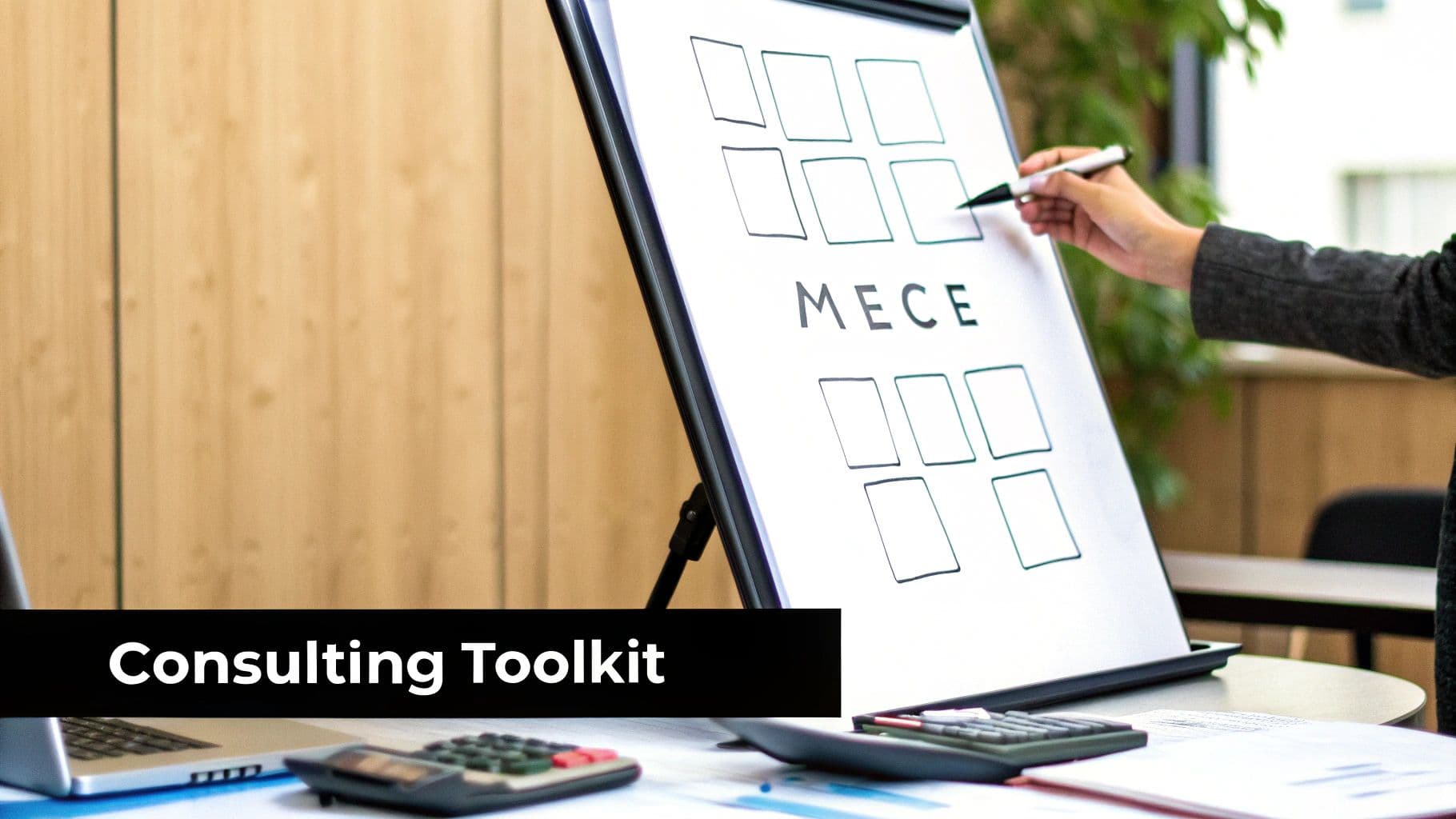
Forget memorizing dozens of frameworks. Acing the case interview is about forging a handful of powerful, versatile mental tools that you can apply to any business problem. Think of it as building your personal consulting toolkit, and the very first tool you need is structured thinking.
The bedrock of structured thinking is the MECE principle: Mutually Exclusive, Collectively Exhaustive. It’s a fancy way of saying you need to break a big, messy problem into smaller pieces that don't overlap but, when combined, cover all the bases.
This isn't just consultant-speak; it's the intellectual engine that drives problem-solving. When an interviewer throws a complex case at you, they’re really testing your ability to create order out of chaos. A MECE structure is your first and best chance to show you can do just that.
Mastering Structured Thinking with MECE
Let’s make this real. Imagine a case about a struggling coffee shop chain. A scattershot, non-MECE approach might involve blurting out random ideas: "new marketing," "better coffee," "fire the baristas." It's disorganized and leaves huge blind spots.
A MECE approach, on the other hand, starts with something fundamental, like the profitability equation: Profits = Revenues - Costs. This is inherently MECE. From there, the path becomes clear as you break each piece down further:
- Revenues can be split into (Price per Customer) x (Number of Customers).
- Costs can be divided into Fixed Costs (rent, salaries) and Variable Costs (coffee beans, cups).
This simple breakdown instantly creates a logical map to guide your investigation. You can now systematically explore each branch of this "issue tree" without missing crucial details or repeating yourself. This is what top-tier problem-solving looks like.
Moving Beyond Rigid Frameworks
While it’s good to know the classic frameworks, the real goal is to treat them as flexible mental models, not as rigid scripts you recite from memory. The best candidates understand the why behind a framework and know when to adapt, blend, or even discard it.
For example, a standard profitability framework is perfect for diagnosing a company's internal issues. But what if the case is about a competitor launching a game-changing product? Your structure must expand to include external market forces. Often, the winning approach is a custom one, blending elements from different models to fit the unique contours of the problem at hand.
True mastery isn't about knowing ten frameworks. It's about deeply understanding the business logic behind one or two, like profitability, and then having the creative confidence to build a custom structure for any prompt you receive.
Developing this kind of flexibility takes practice. To get a better handle on the underlying logic, our guide on how to choose the right framework for case interviews is a great place to start. And to really build out your toolkit, it helps to understand the principles of data-driven decision making.
Nailing the Numbers with Mental Math
Consulting is a numbers game. You absolutely must be comfortable with mental math, performing calculations quickly and accurately while under pressure. We're not talking about advanced calculus here—this is about mastering the arithmetic that drives business.
Get sharp by focusing your practice on these key areas:
- Large Number Arithmetic: Get comfortable adding, subtracting, multiplying, and dividing numbers in the millions and billions. Being able to confidently state that "1.5 billion divided by 300 million is 5" is a must-have skill.
- Percentage Calculations: You need to be fast with percentage growth, discounts, and margins. If revenue grew from $40M to $50M, you should instantly know that’s a 25% increase.
- Breakeven Analysis: This is a business fundamental. Practice calculating how many units a company has to sell just to cover its fixed costs.
The goal is to make these calculations second nature. Using targeted tools like the guided math drills in Soreno can help you get the reps you need to build both speed and confidence.
From Data to Insight: Chart Interpretation
At some point, you’ll likely be handed a chart and asked, "What does this tell you?" A weak answer is to just read the labels aloud. The strong answer is to unearth the "so what?"—the critical business insight hiding in plain sight.
When you get a chart, use this simple three-step process:
- Understand It: First, orient yourself. What are the axes? The units? The title? Take five seconds to get your bearings.
- Find the Key Takeaway: Scan for the most significant trend, the most dramatic comparison, or the most surprising outlier. Is one customer segment growing way faster than the others? Is there an unexpected correlation?
- State the Implication: This is where you shine. Connect your key takeaway directly back to the client's problem. For example: "This chart shows that while our overall sales are flat, our premium product segment has grown by 40%. This suggests our growth strategy should be laser-focused on this high-value segment."
This ability to turn raw data into a strategic recommendation is what separates the average candidate from the one who gets the offer. It proves you can think like a real consultant.
Conquering Market Sizing and Quantitative Questions
Market sizing questions are a classic for a reason. An interviewer might hit you with something like, "Estimate the annual revenue for Netflix in Germany," or, "How many tennis balls are sold in the U.S. each year?" It's a pure, unfiltered test of your ability to structure a messy problem, make sound assumptions, and work with numbers on the fly.
Here’s the secret: these questions aren't about getting the right answer. No one expects you to know the exact number of tennis balls sold. Instead, they are a golden opportunity to show off your structured thinking. The interviewer cares infinitely more about how you get to your number than the number itself.
The Two Core Estimation Methods
When you get a market sizing prompt, you almost always have two paths you can take: top-down or bottom-up. Knowing when to use each is key, and it gives you the flexibility to tackle any problem that comes your way.
A top-down approach is exactly what it sounds like. You start with a huge, known number—like the total population of a country—and then you start slicing it down with logical filters. To estimate the number of smartphones in Brazil, you’d start with the population, break it down by age, estimate smartphone ownership for each group, and then add it all up.
On the other hand, a bottom-up approach starts small and builds up. To figure out the annual revenue of a single Starbucks, you might estimate customers per hour, multiply by operating hours and the average ticket price, and then you have your number for one store.
This image gives a great visual of how a top-down approach works by breaking a big population into smaller, more manageable pieces.
See how it’s not just one big guess? The problem is split into smaller, more defensible estimates for different groups. That’s what makes your final answer much more credible.
Walking Through a Market Sizing Question
Alright, let's make this real. The interviewer leans in and asks, "Estimate the size of the U.S. market for organic toothpaste." It’s a classic prompt that forces you to think on your feet.
These kinds of questions are a huge part of case prep for a reason. They test your analytical mind and math skills by forcing you to estimate a market in a structured way. For example, 'How many iPhones are sold annually in the United States?' You'd likely start top-down: the total U.S. population is roughly 330 million. From there, you'd estimate the percentage who own a cellphone, the slice of those who own an iPhone, and finally, how often they upgrade. You can find more great insights from experts in case interview basics who break this down further.
Here’s how you could structure your response to the toothpaste question:
- Clarify and State Assumptions: Don't just dive in. First, clarify exactly what they're asking. "By 'market size,' are we talking about annual revenue in dollars, or the number of tubes sold?" Then, lay out your baseline assumptions. "Okay, I'll assume the U.S. population is 330 million and the average life expectancy is about 80 years, which will help me segment by age."
- Lay Out Your Structure: Tell the interviewer your game plan before you start calculating. "My plan is to take a top-down approach. I’ll start with the U.S. population, segment them by their likelihood to buy organic products, estimate how much toothpaste they use a year, and then calculate the total market value from there."
- Execute the Calculation (Out Loud): This is critical—don't go silent while you do the math. Talk through every step. It lets the interviewer follow your logic, and if you make a small slip-up, they can nudge you back on track.
The candidates who really nail this treat it like a collaborative conversation. They check in, state assumptions clearly, and use simple, round numbers to keep the math transparent and easy for everyone to follow.
The Importance of Sanity Checking
You've done the math and arrived at a number. You're not done yet. The final, and arguably most important, step is to do a quick "sanity check." Does your answer actually make sense in the real world?
For instance, if you calculated the U.S. organic toothpaste market to be $50 billion, that should set off alarm bells. Is it really plausible that this small niche is bigger than the entire global coffee market? Probably not. A quick sanity check lets you backtrack, find the flawed assumption (maybe your price per tube was way too high), and make an adjustment.
This final step is what separates a good candidate from a great one. It shows you're not just a calculator; you're a strategic thinker with real business sense. To see more detailed breakdowns and get your reps in, check out our complete guide on mastering market sizing questions.
Developing Real-World Business Acumen
Solving the case is only half the battle. Anyone can learn a framework, but the candidates who land offers are the ones who can think beyond it. They understand the real-world business context behind the problem, and that’s where business acumen—or "business intuition"—comes in.
Frankly, this is the single biggest differentiator between a good candidate and a hire. It’s not something you’re born with; it's a skill you build by getting genuinely curious about how business actually works. This curiosity helps you ask smarter questions, make more realistic assumptions, and deliver recommendations that feel grounded, not just academic.
Why Knowing a Few Key Numbers Is a Game Changer
Imagine you’re in a market entry case for a new soft drink in Latin America. A candidate without much business context might start by asking, "So, what's the population there?" It's a fair question, but it immediately signals they're starting from zero.
A candidate with strong business intuition, however, already knows the ballpark figure. They can immediately start making smarter, more nuanced assumptions, which moves the case forward much faster.
This is where committing a few key global statistics to memory gives you a massive advantage. These aren't just trivia; they’re benchmarks that let you make quick, defensible estimations on the fly. Interviewers expect you to have a working knowledge of figures like the global population (around 8 billion) or the Gross World Product (roughly $96 trillion USD). Knowing Latin America has a population of about 661 million provides instant scale for any market sizing exercise in that region.
When you have these numbers handy, you can ground your logic in reality, which builds tremendous credibility. For more essential figures, check out these helpful insights on case interview statistics.
Essential Figures to Have in Your Back Pocket
You don’t need to memorize an encyclopedia. Just having a handful of key figures at your fingertips is enough to make you look sharp and feel more confident. The goal is to have numbers that provide scale and context.
Here are a few great ones to start with:
- Global Population: ~8 billion people
- U.S. Population: ~330 million people
- EU Population: ~450 million people
- China Population: ~1.4 billion people
- India Population: ~1.4 billion people
- World GDP: ~$95-100 trillion
- U.S. GDP: ~$25 trillion
- Smartphone Penetration (Developed Markets): Typically 80-90%
Having these ready allows you to quickly sanity-check your calculations and show you have a practical understanding of how big different markets really are.
How to Actually Cultivate Your Business Intuition
Beyond memorizing stats, the best way to develop real business acumen is to actively engage with the business world every single day. This isn't about cramming for hours; it's about building simple, consistent habits.
Pick one or two reputable business publications you enjoy reading, like The Wall Street Journal, The Economist, or Bloomberg Businessweek. But don't just skim the headlines. When you read an article—say, about a major acquisition or a new product launch—ask yourself a few questions:
- Why is this company really making this move?
- What market trends are pushing them to do this now?
- Who are their main competitors, and how are they going to react?
- What are the biggest risks here? What could go wrong?
Thinking like a consultant means turning passive reading into an active analysis. It's a mental muscle. The more you exercise it by questioning the business news, the stronger and more intuitive your problem-solving will become during a real case.
This simple habit does more than just fill your head with facts. It trains you to see the strategic story behind the numbers, which is exactly what your interviewer is looking for. This demonstrated curiosity will make your recommendations infinitely more powerful.
How to Structure Your Practice for Maximum Impact
I’ve seen countless candidates fall into the mindless repetition trap. They churn through dozens of cases, thinking volume is the key, but they just end up reinforcing the same bad habits. The secret isn't how many cases you do—it's how you do them. A smart, structured plan turns random effort into real, focused progress.
Think of it like learning to play guitar. You don't jump into a complex solo on day one. You master the basic chords, practice your scales, and get the rhythm down. Case prep works the same way. You have to build the foundational skills first.
From Foundational Drills to Integrated Practice
The first phase of your prep should be all about high-repetition, low-complexity exercises. The goal here is to build muscle memory for the core components of a case so they become second nature. When you're not struggling with the basics, you can free up your brain to focus on the bigger strategic picture during a real interview.
Your drill-based practice should zero in on a few key areas:
- Structuring Drills: Grab a list of 20 different case prompts. For each one, give yourself just three minutes to sketch out a clean, MECE (Mutually Exclusive, Collectively Exhaustive) framework. That's it. Don't solve it, just structure it.
- Mental Math Scenarios: This is non-negotiable. Use tools like Soreno’s guided math drills to hammer through calculations with large numbers, percentage growth, and breakeven points. You’re training for both speed and precision under pressure.
- Chart Interpretation Sprints: Find business charts—online, in The Economist, wherever. Give yourself 60 seconds to look at a chart, pull out the single most important insight, and say its business implication out loud.
Once you feel confident in these isolated skills, it's time to start putting it all together. Begin by walking through full cases on your own, without a timer. Just focus on your process. Then, add the clock to simulate real interview pressure before finally graduating to mock interviews with a partner.
Finding and Maximizing Practice Partners
Practicing with another person is where the rubber meets the road. It’s the best way to mimic the back-and-forth of a real case interview. But finding the right partner can be tough. Look for people in MBA programs, consulting clubs, or online case prep forums who are just as serious about this as you are.
When you find them, make your sessions count. It's not just about running through a case; it's about the quality of the feedback. Don't let your partner get away with a simple, "Yeah, that was good." Push for specific, actionable advice.
A great practice partner doesn't just read you a case. They push your thinking, challenge your assumptions, and give you brutally honest feedback on where your logic fell short. That's the only way to get better.
On that note, don't forget the little things that make a big difference. Nailing down effective note-taking strategies for interviews can be a game-changer, helping you keep your thoughts organized and your presentation sharp.
Creating a Powerful Feedback Loop
If you want to get better with every single case, you can't just rely on gut feelings. You need a system. A simple scoring rubric can turn vague feedback into objective analysis, creating a powerful cycle of improvement.
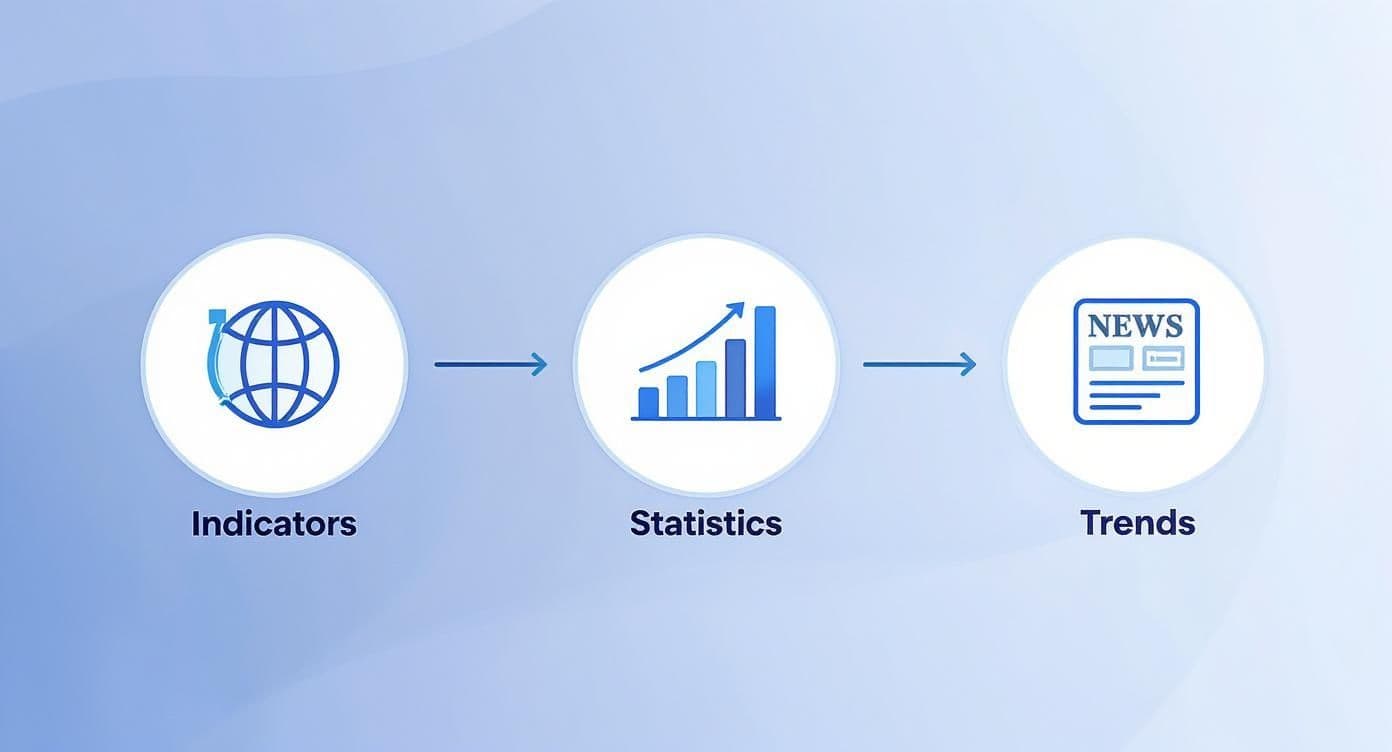
This is how strong business sense is built—by connecting the dots between high-level indicators, raw data, and actionable trends.
After each mock interview, rate the performance on a simple 1-5 scale across the key pillars of a case. This makes your progress tangible and immediately shows you where you need to focus next.
Sample Performance Rubric
| Category | Score (1-5) | Comments for Improvement |
|---|---|---|
| Case Structuring | 3 | "The initial framework was solid but could have been more tailored to the industry specifics mentioned in the prompt." |
| Quantitative Rigor | 4 | "The math was accurate, but you could have been faster. Let's focus on large number multiplication drills." |
| Business Insight | 2 | "The analysis was correct, but we need to work on translating the 'what' from the data into the 'so what' for the client." |
| Communication | 4 | "Great energy and clarity. Try to use fewer filler words like 'um' when transitioning between topics." |
By tracking these scores over time in a simple spreadsheet, you’re creating a data-driven path to improvement. Platforms like Soreno can automate this with AI-driven scoring, but the principle is simple enough to do on your own. This system ensures every case you do makes you measurably better than the last.
Common Case Prep Questions (And Straightforward Answers)
As you dive into case prep, you're going to have questions. Everyone does. It's easy to get stuck wondering if you're practicing the right way or doing enough. Let's clear up some of the most common questions I hear from candidates so you can spend less time worrying and more time preparing.
How Many Cases Is Enough?
There’s no magic number here, and honestly, quality beats quantity every single time. Most candidates who land offers have done somewhere between 30 and 50 high-quality live mock interviews.
The real key isn't just hitting a number; it's about getting variety. You need to see different industries, functions, and case types. Rushing through 100 cases with shallow feedback is a waste of time. You'll learn far more from doing 40 cases where you spend real time dissecting the feedback and working on your specific weaknesses. Keep a journal or use a tool to track your performance on things like structuring, math, and your final recommendation. That's how you improve instead of just repeating the same mistakes.
What's the Best Way to Get Faster at Mental Math?
The only way to get better at case math is through consistent, focused practice. Don't just do random calculations; be strategic about it.
- Nail the fundamentals first. Get comfortable working with large numbers (millions and billions), calculating percentages quickly, and running breakeven analyses. These are the bread and butter of case math.
- Make it part of your day. Try calculating the tip at a restaurant in your head, estimating your grocery bill while you shop, or figuring out growth rates from a headline in a business article.
- Use specialized tools. There are great apps and platforms out there specifically for case interview math drills. They provide the repetition you need to build both speed and accuracy under pressure.
The goal isn't just to be a human calculator. It's to make the math feel so automatic that you can focus your brainpower on the bigger picture.
Remember, the interviewer cares less about the final number and more about how you get there. Calmly walking them through your logic step-by-step is a skill you have to build, just like the calculation itself.
What if I Get a Case in an Industry I Know Nothing About?
First, don't panic. This happens all the time, and frankly, interviewers expect it. They aren't testing your prior knowledge of niche industries; they're testing your ability to think logically and ask smart questions when faced with something new.
The trick is to own it. Acknowledge your lack of familiarity and immediately pivot to asking great clarifying questions.
For instance, you could say something like, "I haven't had much exposure to the specialty chemicals industry before. To get started, could you walk me through the basic business model? For example, how do companies in this space typically make money, and what are their biggest cost drivers?"
This approach shows you're intellectually curious and mature, turning a potential weakness into a perfect opportunity to demonstrate your problem-solving skills from scratch.
What Are the Biggest Mistakes People Make?
I've seen so many otherwise sharp candidates stumble over the same few hurdles. If you can avoid these three common pitfalls, you'll already be ahead of the pack.
- The "Framework Dump." This is when a candidate hears a prompt, immediately slaps a generic framework on it (like Porter's Five Forces), and starts talking. Big mistake. You must listen carefully to the prompt and build a structure that's tailored to the client's specific problem.
- The "Math Panic." It’s so easy to get flustered when the numbers come out. The key is to take a breath, state your approach out loud before you start calculating, and talk through each step. It’s always better to be slow and correct than fast and wrong.
- The "Data Rabbit Hole." Some candidates get so lost in analyzing a specific chart or piece of data that they forget the main objective. Constantly ask yourself, "How does this help me answer the client's core question?" Always bring it back to the big picture.
Ready to stop guessing and start improving with data-driven feedback? Soreno provides an AI mock interviewer that gives you unlimited, on-demand practice with rubric-based scoring on every skill, from structuring to communication. Start your free trial today and accelerate your case interview prep at https://soreno.ai.