
Your Go-To-Market Strategy Framework for a Flawless Launch
Build a winning launch plan with our go-to-market strategy framework. This guide breaks down core pillars, real-world examples, and a step-by-step playbook.

A go-to-market (GTM) strategy framework is your complete blueprint for launching a product and winning over customers. Think of it as the master plan that gets your product, marketing, and sales teams all marching in the same direction. Without it, even the most brilliant products can easily get lost in the noise.
Why a GTM Framework Is Your Launch Blueprint

Imagine pouring years into developing a game-changing product, only to watch it flop on launch day. It's a painful thought, but it's the reality for a shocking 95% of the 30,000+ new products that hit the market every year. The culprit usually isn't a bad product; it's the lack of a clear plan.
A go-to-market strategy framework is built to prevent this exact nightmare. It's not just another marketing plan or a sales script. It's a comprehensive, cross-functional playbook that forces you to answer the tough questions before you spend a dime on the launch.
This structured approach is all about turning assumptions into data-backed decisions. For a deeper dive into the core concepts, check out this essential guide to Go-To-Market strategy.
The Purpose of a Structured GTM Plan
So, what does a GTM framework actually do? It systematically lays out how you'll connect with your target customers and carve out a competitive edge. It becomes the roadmap for the entire company, giving everyone total clarity and alignment from day one.
A solid GTM framework helps you nail down the essentials:
- Identify your ideal customer: Pinpoint exactly who you're selling to and what pain point you solve for them.
- Define your value proposition: Articulate, in simple terms, why your product is the best possible solution.
- Establish your market position: Get a clear view of the competitive landscape and where you fit in.
- Choose the right channels: Figure out the most effective ways to reach your audience—whether that’s through direct sales, digital marketing, or strategic partnerships.
Ultimately, this guide is designed to be more than just theory. It's a practical playbook meant to give you the tools to build and execute a go-to-market strategy that drives real growth and helps you sidestep those common launch disasters.
Turning Strategy Into Actionable Steps
Without a framework, teams tend to drift into their own silos. Marketing might run a campaign targeting one type of customer, while the sales team is busy chasing a completely different one. Meanwhile, the product team could be adding features that don't even support the core value proposition. This kind of disconnect burns through resources and creates a muddled, confusing experience for your customers.
A GTM framework isn't about boxing people in; it's about channeling their efforts. It sets up the guardrails that empower your teams to innovate and execute with confidence, knowing they're all pulling toward a shared goal.
This guide will walk you through the entire process, from understanding the core pillars to applying them step-by-step. By the end, you won't just know what a go-to-market strategy framework is—you'll be ready to build one that sets your product up for a successful launch.
The Core Components of a GTM Framework
Before you can build a house, you need a solid blueprint. The same goes for launching a product. A go-to-market strategy isn't built on gut feelings; it’s a carefully designed plan resting on a few core components that give it structure and a clear path forward.
Think of these as the non-negotiable parts of your launch plan. If you get one wrong, the whole thing can wobble. Let's break down the foundational elements that every great GTM strategy is built on.
Sizing Your Market: Know Your Playground
First things first: you need to understand the size of the "playground" you're about to enter. This isn't just some academic exercise—it’s about grounding your big ambitions in cold, hard reality. A classic mistake is claiming you’re going after a massive, multi-billion-dollar industry without knowing which tiny corner you can actually win.
To get a real-world picture, you need to break down your market into three distinct layers:
- Total Addressable Market (TAM): This is the big one—the total global demand for a product or service like yours. It’s the entire pie.
- Serviceable Available Market (SAM): This is the slice of the pie you can realistically serve with your product, given your geographical reach, language, and specific features.
- Serviceable Obtainable Market (SOM): Now we're getting practical. This is the portion of your SAM you can realistically capture. It's your target market, taking into account your competition, resources, and brand awareness.
Getting this right stops you from chasing markets that are too small to support you or too big and crowded to compete in. It gives you a realistic target to aim for. For a deeper dive on this, check out our complete guide to sizing the market.
Defining Your Ideal Customer Profile (ICP)
Once you know the size of your playground, you need to decide who you’re playing with. This is where your Ideal Customer Profile (ICP) comes in. Think of it as a "most wanted" poster for your perfect customer—the one who gets the most value from what you offer and, in return, gives the most value back to your business.
An ICP isn't just a vague persona. It's a laser-focused description of the exact company that is a perfect fit for you. It covers firmographics (like industry, company size, and revenue) and the specific, nagging pain points they're trying to solve. Companies that skip this step end up trying to sell to everyone, which really means they're selling to no one.
A sharp ICP is the North Star for your entire GTM strategy. It shapes your marketing messages, guides your product roadmap, and tells you exactly which channels to focus on.
Nailing Your Value Proposition and Positioning
With your ICP in hand, you can build the next crucial piece: your value proposition and positioning. This is where you answer the most important question: why should your ideal customer choose you over anyone else?
Your value proposition is a simple, powerful promise. It clearly explains the tangible benefits your product delivers and instantly answers the customer's "What's in it for me?" question.
Positioning is a bit different. It’s about carving out a specific spot in your customer's mind relative to your competitors. Are you the budget-friendly option? The premium, white-glove service? The most innovative newcomer? According to one study, 77% of consumers buy from brands that share their values, so staking your claim is more critical than ever.
Setting Your Pricing and Choosing Your Channels
The last two components are all about connecting your product to your customer's wallet and their world.
Your pricing strategy needs to be a direct reflection of the value you provide. It's not just about covering your costs; it's a signal of your product's worth. You might opt for a freemium model to drive adoption, a recurring subscription, or value-based pricing where the cost is tied directly to the customer’s ROI.
Finally, your distribution channels are the roads that lead your product to the customer. This isn't just about logistics—it’s about meeting your ICP where they already are. Will you use a direct sales team for complex enterprise deals? A self-serve online checkout for smaller customers? Or a network of partners and resellers to expand your reach? The right channels create a frictionless path from discovery to purchase, locking in the final piece of your GTM framework.
Building Your GTM Strategy: A Step-by-Step Playbook
Turning a great idea into a market success doesn't happen by accident. This is where the theory hits the road. This playbook is designed to walk you through building a powerful go-to-market strategy from the ground up, moving from the big-picture decisions right down to the nitty-gritty of execution. Let's build a plan that gets everyone on the same page and primed for a strong launch.
Think of the process as a logical flow: you start with the wide-angle view of the market, zoom in on your customer, define your unique value, and then figure out your pricing.
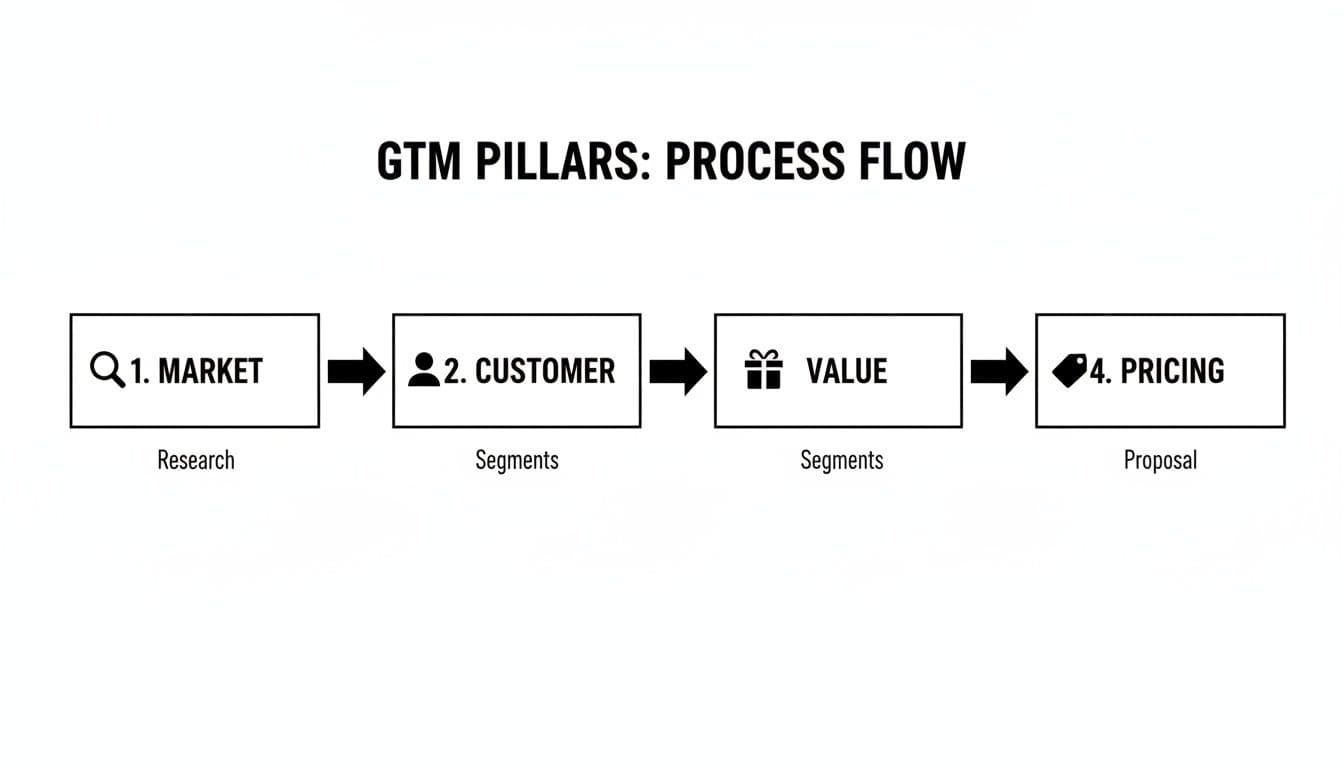
This visual is a great reminder that every step builds on the last. You can't price a product until you know its value, and you can't define its value until you understand who you're selling to.
Step 1: Set Clear, Measurable Goals
Every solid strategy starts with knowing where you're going. Before you get lost in the weeds of tactics, you need to define what success actually looks like in real, measurable terms. Vague ambitions like "increase sales" just won't cut it—you need specific targets that your entire company can rally behind.
For instance, a much stronger goal is: "Achieve $5 million in Annual Recurring Revenue (ARR) in the first fiscal year." It’s specific, measurable, achievable, relevant, and time-bound (SMART). Simple as that.
Setting clear goals from the outset acts as a compass for every subsequent decision. It ensures that every marketing campaign, sales call, and product update is purposefully driving toward the same outcome.
Step 2: Conduct Deep Competitor Research
Knowing your competition is absolutely non-negotiable. You have to understand who you’re up against to figure out where you fit in and how you can stand out. This isn't just about making a list of competitors; it's about a deep-dive analysis of their strengths, weaknesses, and how they’ve positioned themselves in the market.
Get started by digging into their products, their messaging, and what their customers are saying on review sites like G2 or Capterra. You'll quickly find out what people love, what drives them crazy, and where the real opportunities are hiding. This intel is gold for carving out your unique space.
Step 3: Craft Your Core Messaging and Customer Journey
Now that you have your goals and a lay of the land, it’s time to nail your messaging. This is the story you tell your Ideal Customer Profile (ICP) that clearly communicates your value. It needs to hit them right where their pain points are and make it obvious why your product is the solution they’ve been looking for.
At the same time, you need to map out the entire customer journey. Sketch out every single touchpoint a potential customer will have with your brand, from the moment they first hear about you to when they click "buy" and beyond. Understanding this path is what allows you to create an experience that feels seamless and persuasive, not clunky and disjointed.
Step 4: Choose Your Primary Sales Motion
Okay, so how are you actually going to sell this thing? Your sales motion is the engine of your GTM strategy, and picking the right one is critical. The two most common models are product-led and sales-led, and they're built for very different products and markets.
- Product-Led Growth (PLG): The product itself is the main driver for getting and keeping customers. Think about tools like Slack or Dropbox, where you can sign up, start using it, and see the value right away—often without ever talking to a human. It's a perfect fit for high-volume products that don't need a lot of hand-holding.
- Sales-Led Growth (SLG): Here, a traditional sales team does the heavy lifting to bring in revenue. This is the go-to model for complex, big-ticket items like enterprise software from SAP or Oracle. When you have a long sales cycle with multiple decision-makers, you need that high-touch, consultative approach.
You’d be surprised how many companies skip this foundational work. In fact, a shocking 15.4% of companies operate without any defined GTM strategy, which is a huge gamble. As the Go-to-Market Alliance's latest research points out, a structured playbook helps avoid this by making every step intentional.
Choosing Your Sales Motion: Product-Led vs. Sales-Led
Deciding between PLG and SLG is a pivotal choice that shapes your entire organization. This table breaks down the key differences to help you see which path aligns best with your product and customers.
| Attribute | Product-Led Growth (PLG) | Sales-Led Growth (SLG) |
|---|---|---|
| Primary Driver | The product itself drives acquisition, activation, and retention. | A dedicated sales team engages leads and closes deals. |
| Customer Target | Individuals and small to mid-sized businesses (SMBs). | Mid-market and enterprise-level companies. |
| Sales Cycle | Short and self-serve; often minutes or days. | Long and complex; can take months or even years. |
| Pricing Model | Freemium, free trial, or low-cost subscription tiers. | High-value contracts, custom quotes, and annual billing. |
| Typical Product | Simple, intuitive, and delivers value almost instantly. | Complex, requires implementation, and solves major business problems. |
| Examples | Slack, Dropbox, Calendly | Salesforce, SAP, Oracle |
Ultimately, the choice isn't always black and white. Many successful companies blend both models, using a PLG approach to land new users and an SLG team to expand into larger enterprise accounts. The key is to start with the motion that best fits your initial target market.
Step 5: Activate Your Channels and Prepare for Launch
This is it—time to flip the switch. The final step is to fire up your chosen marketing and sales channels and get everything buttoned up for launch day. This means getting your content out there, kicking off ad campaigns, and making sure your sales team has the training and tools they need to hit the ground running.
Resource allocation is everything here. You have to make sure your teams have the people and budget to actually execute the plan you’ve laid out. If you're scaling up your team for the launch, our guide on what is capacity planning offers a great framework for making sure your resources match your strategic goals.
Finally, set up a tight feedback loop between marketing, sales, and product. This is how you’ll capture early learnings, fix what isn't working, and make sure your support team is ready for the wave of new customers. This agile approach is what turns a good go-to-market strategy framework into one that drives real, sustainable growth.
Learning from Real-World GTM Frameworks
Theory is great, but seeing a go-to-market strategy framework blow up in the real world is where the real learning happens. The best way to grasp these models is to pull apart how iconic brands did it. By looking at their choices, we can steal a few pages from their playbooks for our own launches.
These companies didn't just get lucky. They absolutely nailed specific parts of their GTM framework, getting their product, sales, and marketing teams marching in perfect lockstep. Let's look at how three wildly different companies—Slack, Oracle, and Oatly—used distinct GTM models to conquer their markets.
Slack: The Product-Led Growth Revolution
Slack is the poster child for Product-Led Growth (PLG). Instead of hiring a massive sales force to pound the pavement, Slack's whole GTM strategy was built around one simple idea: make the product so ridiculously good and easy to try that it sells itself.
Their freemium model was the gas in the tank. It let anyone, from a single person to a small team, start using Slack for free. They could see how valuable it was firsthand and quickly became its biggest fans. This created a powerful "bottom-up" effect, where the tool spread like wildfire inside companies.
Here’s what made Slack’s PLG framework tick:
- Frictionless Onboarding: You could sign up and have a workspace running in minutes. That "aha moment" of seeing all your conversations organized in channels happened almost instantly.
- Built-in Viral Loops: The core reason to use the product—inviting your coworkers to chat—was also its main growth engine. Every new user brought in more users, naturally.
- Data-Driven Upgrades: Slack wasn't guessing. They watched usage data like a hawk to see when teams were about to hit the limits of the free plan, then prompted them with a perfectly timed offer to upgrade.
Slack proved that when your product is the main driver for attracting and converting customers, you can scale to incredible heights without a massive customer acquisition cost. The product literally becomes your best salesperson.
Oracle: The Enterprise Sales-Led Machine
On the complete other side of the coin, you have Oracle, a giant built on a traditional Sales-Led Growth (SLG) model. You can't exactly sell complex, multi-million dollar enterprise databases with a self-serve checkout button. Their GTM framework was all about high-touch, relationship-driven selling.
Oracle’s strategy aimed squarely at the C-suite of Fortune 500 companies. The sales cycles were long and complex, often roping in dozens of decision-makers and requiring countless demos and custom proposals. A well-defined market entry strategy framework was absolutely essential for them to crack into these huge, complicated organizations.
This approach demanded a totally different set of skills:
- A Highly-Trained Sales Force: Oracle poured money into building an elite direct sales team that knew how to navigate tricky corporate politics and communicate massive value propositions.
- Account-Based Marketing (ABM): Their marketing wasn't a shotgun blast. It was a laser beam, hyper-focused on specific high-value accounts to support the sales team with tailored content and executive events.
- High Lifetime Value (LTV): Because their products were so expensive and "sticky," the huge investment in a direct sales force made perfect financial sense.
Oracle’s long-term dominance shows that for big-ticket, complex products, you need a dedicated sales team to hold the customer's hand through a tough buying journey and close those game-changing deals.
Oatly: The Channel-Led Cult Following
Oatly’s journey from a niche Swedish brand to a global oat milk phenomenon is a brilliant lesson in a channel-led strategy. Instead of fighting for a tiny spot on a crowded supermarket shelf right away, Oatly took a smarter, more subversive path to win people over.
Their first move was to partner with hip, third-wave coffee shops. This was a stroke of genius. Baristas—the ultimate taste-makers in the coffee world—became Oatly’s best and most authentic advocates. Customers first tried the product in a high-end environment, connecting it with top-quality coffee and a cool, indie vibe.
This channel-first approach created a genuine cult following. By the time Oatly finally showed up in major grocery stores, they weren't some unknown brand. There was already a massive, built-in demand from people who were already fiercely loyal, making their retail launch feel less like a product release and more like a victory lap.
How to Measure Success and Avoid Common Pitfalls
A brilliant go-to-market strategy is just a theory until you see the results. Without clear metrics, you’re flying blind, unable to tell a winning launch from an expensive guess. Measuring success isn’t a vanity exercise; it’s how you validate your assumptions and find the insights you need to get better.
To get a real sense of what's working, you have to track the right Key Performance Indicators (KPIs). Think of these as the vital signs for your GTM plan, giving you a clear, honest look at how it's performing out in the wild. You'll want to focus on the numbers that tell the complete story of your customer economics and how efficiently your funnel is operating.
Essential GTM Performance Metrics
To get started, here are the core KPIs that will tell you if your strategy is hitting the mark:
- Customer Acquisition Cost (CAC): This is your total sales and marketing spend divided by the number of new customers you brought in. A low CAC is a sign of an efficient GTM engine.
- Customer Lifetime Value (LTV): This metric estimates the total revenue you can expect from a single customer over their entire relationship with you. A high LTV means you’re landing valuable, sticky customers.
- LTV-to-CAC Ratio: This is the ultimate health check. A healthy business typically aims for an LTV that's at least three times its CAC—a 3:1 ratio is a solid benchmark for profitability and sustainable growth.
- Conversion Rates: Keep an eye on conversions at every stage of your funnel. Track how many website visitors become leads, how many leads become opportunities, and how many of those opportunities close. This helps you pinpoint exactly where your process is strong and where it’s breaking down.
If you’re looking for a deeper dive into how these metrics apply in tech, this Go-To-Market Strategy Framework for SaaS Growth is a fantastic resource.
Sidestepping Common GTM Mistakes
Even with perfect metrics, many promising launches stumble over predictable, avoidable mistakes. Knowing what these common pitfalls are is the first step to steering clear of them and keeping your strategy on course.
One of the biggest culprits is poor internal communication. When your marketing, sales, and product teams are all operating in their own worlds, the customer experience becomes a mess. That lack of cohesion can tank even the most well-researched go-to-market strategy framework.
A GTM plan is a team sport. Its success depends less on the document itself and more on the alignment of the people who have to bring it to life.
The data backs this up. In one survey, 33.3% of GTM professionals said cross-functional collaboration was the single most important factor for success. It's no surprise that companies with a defined strategy see 15.4% fewer launch failures and achieve 10% higher success rates. A unified playbook makes all the difference. You can read more about these findings on StrategyLadders.com.
To keep your launch on the rails, watch out for these all-too-common missteps:
- Weak Value Proposition: Your message is fuzzy or fails to explain exactly why your product is the best fix for your customer's biggest problem.
- Choosing the Wrong Channels: You pour time and money into marketing or sales channels where your target audience simply doesn't hang out.
- Ignoring Customer Feedback: You don't have a system for listening to early customers, so you miss critical signals that your messaging is off or the product has major gaps.
By tracking the right KPIs and proactively dodging these common mistakes, you can turn your GTM plan from a static document into a living, breathing engine for growth.
Your Go-To-Market Strategy Framework Checklist

We've covered a lot of ground in building out a full-blown plan. Now, let’s boil it all down into a simple, powerful pre-launch audit. Think of this checklist as a way to pressure-test your strategy, making sure every gear is turning smoothly before you go live.
This isn’t just a simple to-do list. It’s a series of tough questions designed to find any weak spots or gaps before they turn into expensive mistakes. It takes the big ideas of a go-to-market strategy framework and turns them into something you and your team can actually use.
Foundational Strategy Audit
Before you even think about tactics, let's make sure the core of your strategy is rock-solid. These questions are all about confirming you’ve nailed down your market and your message with absolute clarity.
- Ideal Customer Profile (ICP): Do we really know who our best customer is? Can we describe their industry, company size, and the exact problems that keep them up at night?
- Market Sizing: Are our TAM, SAM, and SOM numbers based in reality? Do they give us confidence in our investment and help us focus our energy?
- Value Proposition: Can we explain our promise to the customer in less than ten seconds? Is it unique, and does it genuinely solve their problem?
- Positioning: If I asked anyone on the team where we stand against competitors and why we’re the better option, would I get the same, confident answer?
Your go-to-market plan is only as strong as its weakest link. This checklist serves as your final inspection, ensuring every piece is aligned, validated, and ready to contribute to a successful launch.
Execution and Measurement Readiness
Once the foundation is set, it’s all about the execution. This final check ensures your operational plan makes sense and you know exactly how you'll measure success.
- Sales Motion: Have we picked a lane? Are we committed to a primary sales motion—like product-led or sales-led—that actually fits our product's price and complexity?
- Channel Activation: Are our marketing and distribution channels the most direct path to our ICP, or are we just guessing?
- Team Alignment: Is everyone on the same page? Does sales, marketing, product, and support all understand their specific roles and share the same definition of success?
- Success Metrics: Do we have our key numbers locked in? Are we ready to track critical KPIs like CAC, LTV, and conversion rates from the moment we launch?
Answering Common GTM Questions
As you put the finishing touches on your GTM plan, a few questions always seem to pop up. Let's clear the air on some of the most common ones so you can move forward with confidence, knowing your strategy is built on solid ground.
GTM Strategy vs. Marketing Plan: What's the Real Difference?
This is probably the most common point of confusion, and the distinction is crucial. The easiest way to think about it is that a marketing plan is just one chapter in the much larger book of your go-to-market strategy. It’s a vital piece, but it’s not the whole story.
A marketing plan is all about promotion. It answers the question, "How will we attract, engage, and convert our audience?" It gets into the tactical details of campaigns, content creation, social media channels, and brand messaging.
A GTM strategy, however, is the master plan for the entire commercialization effort. It aligns marketing with sales, product development, and customer support to ensure everyone is pulling in the same direction.
Simply put, a GTM strategy defines the who, what, where, and why for the entire business. A marketing plan executes the how for just the marketing team.
How Often Should a GTM Strategy Be Updated?
Your GTM strategy should never be a "set it and forget it" document collecting dust on a shelf. Markets shift, customer needs evolve, and new competitors can pop up seemingly out of nowhere. To stay sharp, you need a living, breathing plan.
A solid rule of thumb is to schedule a comprehensive review every quarter. This gives you enough time to collect meaningful data on what's working (and what's not) while being frequent enough to adapt to market changes. That said, you should be ready to pivot much faster if you spot certain red flags:
- You're consistently missing your KPIs: If your customer acquisition cost is ballooning or conversion rates are tanking, something is wrong.
- A major competitor makes a move: Did a rival just launch a new feature or slash their prices? You can't ignore that.
- Customer feedback shifts: Are you suddenly hearing new objections in sales calls or seeing different feature requests? It might be time to adjust your messaging.
Do Startups Really Need a Complex GTM Framework?
No, and they shouldn't even try to build one. For a startup, a lean, focused GTM framework is infinitely more powerful than some bloated, 100-page document. You don't need a huge budget to make a splash; you need discipline.
The trick is to be ruthless about prioritization. Pour your limited resources into nailing your Ideal Customer Profile (ICP) and carving out a specific, underserved niche. Forget trying to be everywhere at once. Instead, find the one or two channels where your ideal customers spend their time and completely own them. A great startup launch is all about depth, not breadth.
Ready to build the skills for a successful career in consulting or finance? Soreno provides the ultimate AI-powered interview prep platform to master case studies and land your dream job. Start your 7-day free trial today.