
How to Perform SWOT Analysis for Strategic Advantage
A practical guide on how to perform SWOT analysis. Turn raw insights into a winning strategy with actionable steps used by top consultants.
Performing a SWOT analysis is all about taking an honest look at your organization's internal Strengths and Weaknesses, then mapping those against the external Opportunities and Threats you face. It boils down to a simple 2x2 grid that gives you a surprisingly clear, actionable snapshot to drive your strategic planning.
Why SWOT Analysis Is Still a Strategic Powerhouse
Don't dismiss the SWOT analysis as just another business school exercise. In reality, it’s a cornerstone of practical strategic thinking. Its real power comes from its elegant simplicity and its ability to cut through the noise, distilling a complex business environment into a visual, easy-to-understand framework.
The genius of it is how it separates internal factors—the things you can actually control—from external ones, which are the market forces you have to react to. This forces a level of realism that’s often missing in high-level planning meetings.
This framework isn't just for big corporations, either. It’s incredibly versatile, whether you're a startup founder sketching out your first business plan, a marketing manager navigating a sudden market shift, or a consultant prepping for a critical case interview. A well-done SWOT uncovers connections and insights you’d almost certainly miss otherwise.
The Four Pillars of Strategic Insight
To get the most out of it, you first have to nail down what each of the four quadrants really means. They each represent a unique perspective, and together, they give you a full 360-degree view of your strategic position.
-
Strengths (Internal): What do we do better than anyone else? This is about your unique assets—think proprietary tech, a killer brand reputation, a world-class team, or a super-efficient supply chain. These are your competitive advantages.
-
Weaknesses (Internal): Where are we falling short? This requires some honesty. It could be a high cost structure, outdated systems, a key skill gap on your team, or a poor location. These are the internal roadblocks holding you back.
-
Opportunities (External): What’s happening out there that we can jump on? These are favorable external factors you can use to your advantage. Maybe a new market is opening up, a competitor just stumbled, or a new technology could slash your costs.
-
Threats (External): What external forces could sink us? This is your "what-if" list. It could be a disruptive new competitor, changing customer tastes, new regulations, or a looming economic downturn.
The real magic of a SWOT analysis isn't just listing items in each box. It's about seeing the intersections—like how a specific Strength can neutralize a Threat, or how an Opportunity can help overcome a Weakness.
To help clarify these components, here's a quick cheat sheet.
SWOT Analysis at a Glance
This table breaks down the four quadrants, showing what they represent and the fundamental question each one helps you answer.
| Quadrant | Factor Type | Focus | Key Question to Ask |
|---|---|---|---|
| Strengths | Internal | Positive Attributes | "What are our unique advantages?" |
| Weaknesses | Internal | Negative Attributes | "Where are we vulnerable or lacking?" |
| Opportunities | External | Favorable Conditions | "What market trends can we capitalize on?" |
| Threats | External | Unfavorable Conditions | "What external factors could harm our business?" |
Understanding this structure is the key to unlocking the strategic value hidden within your analysis.
A Proven Framework with Deep Roots
The staying power of this methodology is no accident. It actually came out of research conducted at the Stanford Research Institute back in the 1960s. Fortune 500 companies were funding the project because they were tired of their strategic plans failing so often.
The resulting framework helped giants like General Electric dramatically improve their success rates. Today, it’s estimated that an estimated 85% of Fortune 500 firms still lean on it for strategic planning.
This structured approach is what turns vague ideas into concrete points, making it much easier to build a plan that actually works. For a deeper dive into related discussions, check out our dedicated SWOT Analysis tag page. Now, let's get into the nitty-gritty of how to run a SWOT analysis that delivers real strategic value.
Setting the Stage for an Insightful Analysis
A powerful SWOT analysis doesn't just happen. It's built on a solid foundation of deliberate, thoughtful prep work. Too often, teams jump straight into a brainstorming session, and the result is a list of vague, unactionable points. The quality of what you get out is a direct reflection of what you put in at the start.
This whole prep phase is about creating the right conditions for success—asking the tough questions, getting the right people in the room, and bringing the right information to the table. Before you even think about the four boxes, you have to get clear on your purpose.
Define a Razor-Sharp Objective
First things first: what are you actually trying to figure out? A vague goal like "improve the business" is a recipe for an equally vague SWOT. Your objective is the lens through which you'll evaluate every single strength, weakness, opportunity, and threat.
Think about how different the focus becomes depending on the goal:
- Launching a New Product? You'll zero in on things like manufacturing capabilities, gaps in a competitor's product line, and how your target market might react.
- Increasing Market Share in an Existing Region? The conversation shifts completely. Now you're talking about brand perception, competitor pricing, and how effective your sales channels are.
Without that specific target, your team will be pulling in different directions. The whole analysis will feel disjointed. A sharp objective gets everyone rowing in the same direction, solving the same problem.
A SWOT analysis without a clear objective is like a ship without a rudder. You'll generate plenty of activity, but you won't make meaningful progress toward a specific destination.
Assemble a Diverse and Cross-Functional Team
Your next move is to get the right people involved. A SWOT analysis done only by the C-suite is almost guaranteed to have massive blind spots. To see the full picture, you need different perspectives from across the business.
Your goal is to bring together people who see the company from different angles. A killer team might include people from:
- Sales and Customer Service: These are your eyes and ears on the ground. They hear what customers are complaining about, what competitors are up to, and what the general market sentiment is.
- Marketing: This team lives and breathes brand perception, market trends, and what messaging is actually connecting with people.
- Operations and Product Development: They know the reality of your internal processes, production bottlenecks, product flaws, and technology gaps.
When you mix these viewpoints, you start to challenge old assumptions and uncover insights that would have stayed buried. This kind of collaboration is what makes a SWOT analysis feel real and grounded.
Gather Concrete Data Before You Begin
An analysis built on gut feelings and opinions is fragile at best. For a SWOT to have any real teeth, it needs to be backed up by hard data. Pulling this information together before the meeting makes the whole session more productive and keeps the conversation tethered to reality.
Think of it as creating a pre-read packet that gives everyone a snapshot of the internal and external landscape. Here’s what you should be looking for:
| Data Type | Example Information to Gather | Purpose |
|---|---|---|
| Internal Data | Financial reports, employee satisfaction surveys, customer retention rates, production efficiency metrics. | To provide a factual basis for identifying Strengths and Weaknesses. |
| External Data | Competitor analysis reports, market trend studies, customer feedback and online reviews, industry analyst reports. | To inform the discovery of Opportunities and Threats in the wider market. |
Having this data on hand completely changes the conversation. Instead of someone saying, "I think our customer service is good," they can state, "Our customer satisfaction score is 92%, which is 15% higher than the industry average." That's the kind of specific, evidence-based insight that separates a mediocre SWOT from a genuinely strategic one.
Building Your SWOT Matrix with Actionable Data
Alright, you've set your objective and pulled the right people into the room. Now for the main event: constructing the SWOT matrix itself. This is where the magic happens, turning all that raw data and collective knowledge into a clear, structured 2x2 grid. The goal isn't just to fill in the boxes; it's to populate them with specific, evidence-backed points that paint an honest picture of your business.
This all starts with a solid brainstorming session. You need to create an environment where ideas can flow freely without anyone jumping to conclusions or shutting things down too early.
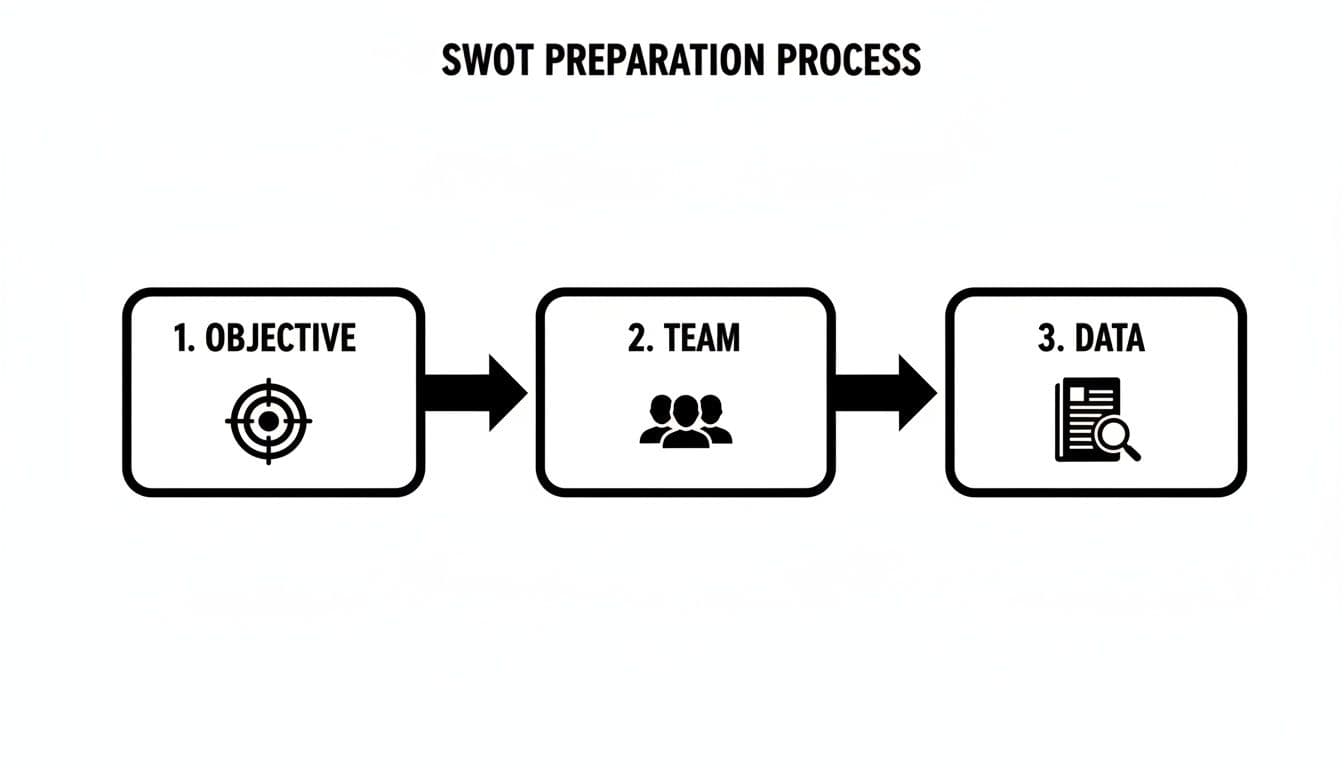
This flowchart really nails the setup. Defining a sharp objective, getting a diverse team on board, and doing your homework by collecting data are the non-negotiable first steps. Get these right, and the insights you generate will actually be relevant and usable.
Prompting Meaningful Brainstorming
Simply asking, "What are our strengths?" is a surefire way to get generic, unhelpful answers. You need to use more targeted questions to spark deeper, more critical thinking. The right prompts can steer the conversation away from vague statements and toward concrete insights.
To get a better feel for this, let's imagine you're a B2B SaaS company. Your questions might look something like this:
- Strengths: "What specific proprietary tech gives us an edge?" or "Which part of our customer onboarding consistently gets the highest satisfaction scores?"
- Weaknesses: "Where are the biggest points of friction for our sales team in our internal processes?" or "Are we missing any critical skill sets in our engineering department?"
- Opportunities: "Is there an underserved customer segment our competition is completely ignoring?" or "How could new AI integrations actually automate valuable tasks for our core users?"
- Threats: "Are there any pending data privacy regulations that could disrupt our business model?" or "Which emerging startup is building something that could make our solution obsolete?"
These kinds of questions force everyone to think in specifics, which is exactly what you need. They tie the brainstorming back to the tangible realities of the business, making the whole exercise far more practical. To see how these internal factors connect to the bigger operational picture, you might find our guide on what value chain analysis is helpful, as it’s a great complement to a SWOT.
To help guide your own session, I've put together a table of questions that I've found useful over the years.
Sample Prompting Questions for Each SWOT Quadrant
| Quadrant | Internal/External | Sample Brainstorming Prompts |
|---|---|---|
| Strengths | Internal | • What do we do better than anyone else? • What unique assets do we control (talent, IP, capital)? • What do our customers love most about us? |
| Weaknesses | Internal | • Where do we consistently underperform? • What resources are we lacking? • What are the most common complaints from customers or staff? |
| Opportunities | External | • What market trends can we capitalize on? • Are there any upcoming regulatory changes that benefit us? • Can we serve a new customer niche with our existing capabilities? |
| Threats | External | • Who are our emerging competitors? • What technological shifts could make us irrelevant? • Are our key suppliers facing any instability? |
Use these as a starting point to get the conversation flowing in the right direction.
From Vague Ideas to Specific Insights
Let's walk through a real-world example. Imagine our SaaS company is brainstorming weaknesses. A typical first-pass comment might be, "our software is buggy." While true, it’s far too general to be useful.
You need to push for more detail. The conversation should evolve like this:
- Vague Idea: "Our software is buggy."
- More Specific: "Customers are complaining that the analytics dashboard keeps crashing."
- Actionable Insight: "The analytics dashboard has a 4% crash rate on Tuesdays due to peak server load, which leads to a 15% increase in support tickets."
Now that is gold. It’s measurable, specific, and points directly to a root cause that the engineering team can actually investigate and solve. This is the level of detail you should be aiming for in every single quadrant.
The most effective SWOT analyses are built on precision. They replace generalities like "good brand" with quantifiable statements like "85% brand recognition in our target demographic" and swap "bad support" for "24-hour average ticket resolution time, which is 40% slower than our main competitor."
Running an Efficient Brainstorming Session
To keep things productive, a little structure goes a long way. I’ve found that the best sessions involve a diverse team of around five to eight people. Set a 60-minute timer and challenge the group to come up with 8 to 12 uncensored items for each quadrant, making sure each point is tied to real data where possible.
For instance, a strength might be a "90% satisfaction rate among customer service reps," while a weakness could be, "Our product is browser-only, alienating the 20% of users who prefer a native app." Once you have your lists, you can quickly prioritize by having the team score each item on a 1-5 scale for both impact and probability. It's a simple way to see what really matters.
By following a structured, data-driven process, you'll transform your SWOT matrix from a simple list into a powerful diagnostic tool. It becomes a clear, honest snapshot of where your business stands today, perfectly setting the stage for building a strategic action plan.
Turning Your SWOT Analysis into a Strategic Plan
Finishing the SWOT matrix feels like a huge accomplishment, but honestly, it’s just the halfway point. A grid full of strengths, weaknesses, opportunities, and threats is nothing more than a snapshot. Its real power is unlocked when you use it to build an actual, forward-looking strategic plan. This is where analysis becomes action.
Just staring at four separate lists won't get you very far. The most potent strategies come from connecting the dots between those lists. To do this, we can evolve the classic SWOT into a more dynamic framework called a TOWS Matrix. It's a clever way to systematically pair your internal reality with the external landscape to cook up some real strategic options.
Introducing the TOWS Matrix Framework
The TOWS Matrix is a simple but brilliant extension of your initial work. Instead of just listing points in boxes, you start actively matching items from different quadrants to brainstorm concrete moves. This simple shift forces you to answer the critical questions that link what you can do with what's happening out there.
This structured thinking pushes you to figure out how your company's unique DNA can be deployed in the real world. While SWOT has been around for ages, it was Heinz Weihrich's 1982 paper that introduced the iconic 2x2 matrix, matching internal factors against external ones. This evolution is what made it a cornerstone of strategic planning, leading to its adoption in over 90% of U.S. business schools by 1990. Research has even shown that companies that laser-focus on their top three opportunities can grow revenues 15% faster. If you're curious about the history, RapidBI.com has a great rundown.
Let's break down the four types of strategies you can create.
Crafting Your Strategic Options
Using the TOWS framework, you’ll end up with four distinct categories of strategies. This process ensures you aren't just reacting to threats or chasing shiny objects in a vacuum. Instead, you're building a cohesive plan that’s actually grounded in your organization's reality.
-
Strength-Opportunity (SO) Strategies: Think of these as your "go on offense" plays. You're looking at your core strengths and matching them up with market opportunities to drive aggressive growth. The question to ask is: How can we use our strengths to really capitalize on these opportunities?
- Real-World Example: Imagine a tech company with a strong, trusted brand (Strength) that spots an emerging market for small business analytics (Opportunity). An SO strategy would be to launch a new, targeted product line under that trusted brand to grab market share fast.
-
Weakness-Opportunity (WO) Strategies: Here, you're focused on shoring up your vulnerabilities by taking advantage of what's happening outside. You’re essentially using an opportunity to fix an internal problem. Ask yourself: How can we leverage these opportunities to overcome our weaknesses?
- Real-World Example: A retail chain is stuck with outdated e-commerce technology (Weakness) but sees a growing trend of customers using mobile payment apps (Opportunity). The WO move? Partner with an established fintech company to integrate a modern payment system, leapfrogging the need to build one from scratch.
Your SWOT analysis provides the 'what,' but the TOWS matrix helps you figure out the 'so what?' It’s the bridge between knowing your position and knowing what to do about it.
-
Strength-Threat (ST) Strategies: This is where you use what you’re good at to neutralize external threats. It's a defensive posture, but a powerful one. The guiding question is: How can our strengths help us dodge or reduce the impact of these threats?
- Real-World Example: A food manufacturer with a highly efficient, low-cost supply chain (Strength) sees the threat of new, low-price competitors entering the market. The ST strategy could be to proactively initiate a price war, using its cost advantage to make it completely unprofitable for new players to gain a foothold.
-
Weakness-Threat (WT) Strategies: These are your most defensive, "batten down the hatches" strategies. The goal is to minimize your weaknesses to avoid getting crippled by threats. It’s all about survival and damage control. You need to ask: How do we minimize our weak spots and avoid these threats?
- Real-World Example: A small consulting firm with very limited cash reserves (Weakness) is staring down an impending economic downturn (Threat). The WT strategy is to immediately cut all non-essential spending, freeze hiring, and focus every ounce of energy on retaining its most profitable clients.
Prioritizing and Executing Your Plan
Once you’ve brainstormed these options, you'll probably have a long list of potential actions. You can’t do everything at once. The final, critical step is to prioritize this list and turn it into an actionable roadmap.
A simple impact/effort matrix works wonders here. Score each potential strategy on the impact it could have and the effort (time, money, people) it would take. Zero in on the high-impact, low-effort initiatives first—those are your quick wins that build momentum.
For every action you decide to pursue, assign a clear owner, set a firm deadline, and define what success looks like with a measurable KPI. For instance, if a key strategy is launching that new product line, a huge piece of that is understanding who you're selling to. You can dig deeper into this by reading our guide on how to calculate your addressable market. By turning your SWOT insights into a structured plan with real accountability, you ensure the entire exercise actually leads somewhere meaningful.
Avoiding Common SWOT Analysis Pitfalls
A SWOT analysis can be an incredibly powerful tool. But I've seen even experienced teams fall into a few common traps that turn a potentially game-changing exercise into a simple box-ticking activity. Knowing what these pitfalls are ahead of time is the best way to make sure your analysis actually drives your strategy forward.

The biggest mistake? Simply stopping once the matrix is filled out. A beautifully crafted SWOT is useless if it just sits in a PowerPoint slide and never leads to action. Remember, the analysis isn't the final product; it's the starting block for building a real strategic plan with clear owners and deadlines.
Moving Beyond Vague Descriptions
Another trap is getting too generic. Statements like "good company culture" or "strong brand" sound nice, but they're strategically useless because you can't measure them. For every point you list, you have to ask yourself, "So what?" and "How do we know?"
This pushes you to get specific and ground your analysis in hard evidence.
-
Instead of: "We have a good company culture."
-
Try: "Our employee turnover is 5% lower than the industry average, and our latest survey showed an 85% employee satisfaction score."
-
Instead of: "We have a strong brand."
-
Try: "We have 70% unaided brand recall in our target demographic, giving us a major advantage over competitors."
See the difference? Specifics turn fuzzy opinions into tangible assets or liabilities you can actually build a strategy around.
The Laundry List Problem
It’s tempting to brainstorm a long, sprawling list for each quadrant, but this can quickly lead to a loss of focus. A SWOT with 20 strengths and 15 opportunities isn't helpful—it's overwhelming. The goal isn't to list everything under the sun; it's to pinpoint the most critical factors.
After you brainstorm, you have to be ruthless about prioritizing. Have your team vote on the top 3-5 items in each category, or use an impact-versus-effort matrix to see what really matters. This discipline sharpens your focus and makes the next step of building a strategy much more manageable.
The point of a SWOT isn't to create a complete inventory of your business. It's to find the handful of factors that will have the biggest impact on where you're going next.
Overcoming Confirmation Bias
We all have our biases. Teams often walk into a SWOT session with preconceived ideas and then look for information that confirms what they already believe. This is a huge risk because it can blind you to real threats or make you overestimate your strengths.
A great way to fight this is to formally assign someone the role of "devil's advocate." Their job is to challenge every assumption. If someone lists "loyal customer base" as a strength, the devil's advocate should ask, "What’s our churn rate compared to last year? Are repeat purchases trending up or down?"
By actively inviting debate and backing up every point with data, you ensure the analysis is an honest, clear-eyed assessment. That rigor is what separates a technically correct SWOT from one that’s strategically powerful.
Using SWOT to Excel in a Case Interview
If you're gunning for a consulting role, think of SWOT analysis as your secret weapon for the case interview. This isn't about filling out a static box on a whiteboard. In a high-stakes interview, you won't have the luxury of time or deep research. SWOT becomes a rapid-fire mental model to structure your thinking on the spot.
As the interviewer lays out the case, you need to be actively sorting the information. Is that a core Strength the company possesses? A glaring Weakness holding them back? A market Opportunity they could jump on? Or a looming Threat on the horizon? This real-time sorting process is critical. It keeps you from drowning in details and helps you start building a coherent story from the very first minute.
From Categorization to Hypothesis
Simply listing points under S, W, O, and T won't land you the job. The real magic happens when you start connecting the dots to form a compelling hypothesis.
For example, what happens when you link an internal Weakness (say, a creaky, outdated supply chain) with an external Threat (like a nimble new competitor entering the market)? Suddenly, you’ve identified a massive business risk. Pointing that out shows the interviewer you can think strategically, not just regurgitate facts.
In a case interview, the SWOT framework isn’t a final destination. It's the launchpad for your strategic recommendations. Your job is to show the interviewer how the quadrants crash into each other to create unique problems or openings.
Articulating a SWOT-Driven Recommendation
Let's run through a quick example. Your client is a legacy brand in the luxury retail world.
Here's the data dump:
- Strength: Incredible brand recognition and loyalty.
- Weakness: A virtually non-existent e-commerce platform.
- Opportunity: The market for online luxury goods is exploding.
- Threat: A new wave of direct-to-consumer online brands is stealing market share.
A novice might just list these out. You need to synthesize them into a sharp, actionable recommendation.
Try this: "Given the client's weak e-commerce presence (Weakness) and the serious challenge from new online competitors (Threat), the situation is urgent. However, by leveraging their powerful brand recognition (Strength), they can aggressively pivot to capture the growing online market (Opportunity) and effectively defend their territory."
This kind of synthesis proves you have a clear, logical thought process rooted in solid strategic analysis. This structured thinking is exactly what top firms are hunting for.
In fact, a 2019 PwC survey found that 68% of global CEOs rely on frameworks like SWOT to navigate uncertainty. More importantly, firms that do are 22% more likely to beat their revenue goals. This approach is a cornerstone of many frameworks for case interviews.
Your Top SWOT Analysis Questions Answered
Even with a step-by-step guide, it's natural to have a few questions when you're getting down to the nitty-gritty of a SWOT analysis. Let's tackle some of the most common ones I hear from teams. Getting these details right can be the difference between a checklist exercise and a genuinely strategic breakthrough.
So, one of the first things people always ask is about the timing. Is this a once-a-year thing, or what?
How Often Should We Actually Do a SWOT Analysis?
For most companies, a deep-dive SWOT analysis is a staple of the annual strategic planning cycle. But in today's world, treating it as a once-and-done event is a real risk. Your market doesn't wait for your annual meeting, and neither should your strategy.
I always advise teams to conduct a quick "health check" on their SWOT at least quarterly. More importantly, certain events should be an immediate trigger for a full review. Think of things like:
- A major new competitor suddenly making waves.
- A game-changing technology that shifts customer expectations.
- An unexpected economic downturn or new government regulations.
If you're in a fast-paced industry like tech or consumer goods, you need to be even more vigilant. More frequent reviews keep you agile and ready to pivot when it matters most.
What’s the Real Difference Between SWOT and PESTLE?
This one comes up all the time. It's easy to mix up SWOT with other strategy tools, especially PESTLE analysis. They're both incredibly useful, but they play different roles. The magic happens when you use them together.
Here’s the simple breakdown: A SWOT analysis looks at both internal factors (your Strengths and Weaknesses) and external factors (the Opportunities and Threats out in the market).
A PESTLE analysis, on the other hand, is entirely focused on the external world. It provides a structured way to scan the macro-environment across six key areas: Political, Economic, Social, Technological, Legal, and Environmental.
Think of it this way: Your PESTLE analysis is the homework you do before the SWOT. It feeds you the rich, detailed insights you need to accurately fill out the Opportunities and Threats sections of your matrix.
Can I Use This for My Own Career?
Absolutely! The SWOT framework is surprisingly versatile and works brilliantly for personal career planning. It’s a fantastic method for taking a step back, doing a structured self-assessment, and figuring out what your next move should be.
When you're doing a personal SWOT, the categories just shift a little:
- Strengths: What are your unique skills, hard-won experiences, or certifications? What do you do better than anyone else?
- Weaknesses: Where are your knowledge gaps? What skills do you need to develop to get to the next level?
- Opportunities: Are there hiring trends in your industry? New skills in high demand? A networking connection you can build on?
- Threats: Could automation impact your role? Is there a flood of new talent competing for the jobs you want?
Laying it all out like this gives you a clear, honest picture of where you stand and helps you build a real strategy for your professional growth.
Ready to ace your high-stakes interviews? Soreno provides the AI-powered practice you need to master frameworks like SWOT in a realistic mock interview setting. Get instant, detailed feedback on your structure, communication, and business insight to walk into your next case interview with total confidence. Start your free trial today at https://soreno.ai.