
10 Classic Interview Brain Teaser Questions to Master in 2025
Unlock winning strategies for the 10 toughest interview brain teaser questions. Detailed solutions & tips to ace your consulting or finance interview.
You’re in the final round for a coveted consulting or finance role. You’ve nailed the technical questions and behavioral fit. Then, the interviewer leans back and asks, “Why are manhole covers round?” This isn’t a trivia question; it’s a test. Your answer, or more accurately, how you arrive at your answer, is the real evaluation. Top-tier firms use interview brain teaser questions not to see if you know the right solution, but to observe your problem-solving process, logical reasoning, and ability to maintain composure under pressure.
They want to see you think, not just recite memorized facts. Can you break down an ambiguous problem into logical components? Can you articulate your thought process clearly and methodically? These puzzles are a proxy for the complex, unstructured challenges you’ll face on the job. Recruiters use them to evaluate a candidate's core analytical abilities; to further develop these critical abilities, you might explore a practical guide on how to improve problem-solving skills. A strong performance demonstrates that you possess the raw intellectual horsepower and structured thinking that defines a top candidate.
This guide moves beyond simple answers. We will dissect 10 classic interview brain teaser questions, providing not just the solutions, but the step-by-step frameworks required to deconstruct them. For each puzzle, we’ll analyze the underlying logic, highlight common traps, and outline a strategic approach to structure your thinking. You will learn what interviewers are really looking for and gain the tools to turn these intimidating challenges into an opportunity to showcase your analytical talent.
1. The Monty Hall Problem
A classic of probability theory, the Monty Hall Problem is one of the most famous interview brain teaser questions used to test a candidate's grasp of conditional probability and logical reasoning. The puzzle places you on a game show with three doors. Behind one door is a car, and behind the other two are goats. You pick a door, say Door #1. The host, who knows what's behind the doors, opens another door, say Door #3, which has a goat. He then asks you: "Do you want to switch your choice to Door #2?"
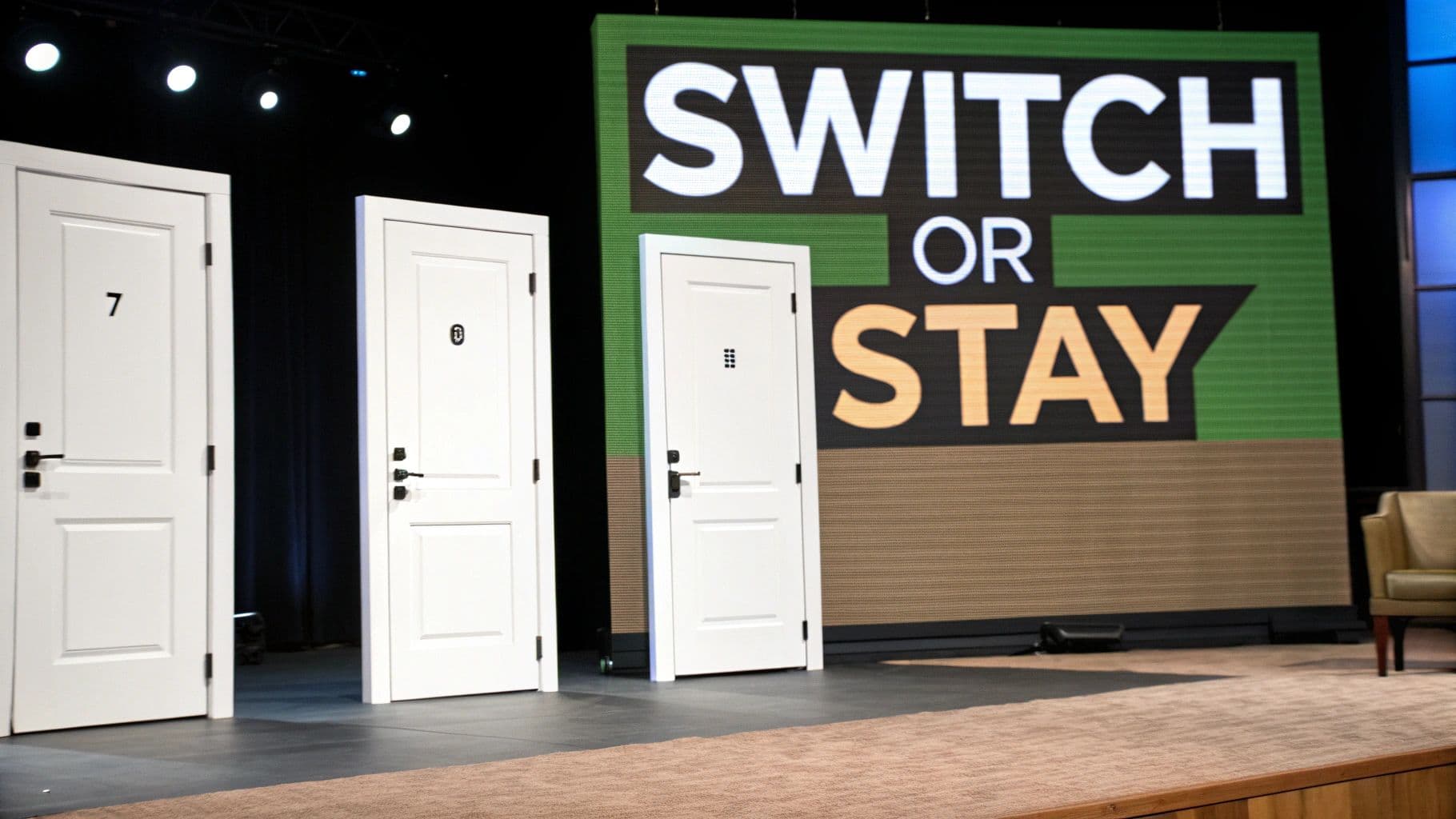
This question isn't about intuition; it's a direct test of your ability to apply probability principles under pressure. The counterintuitive correct answer is that you should always switch. Your initial choice had a 1/3 chance of being right, meaning there was a 2/3 chance the car was behind one of the other two doors. When the host reveals a goat, that 2/3 probability doesn't disappear, it consolidates onto the remaining unopened door.
Strategic Breakdown
- Initial State: Your first pick has a 1/3 probability of being correct. The other two doors combined have a 2/3 probability of hiding the car.
- The Reveal: The host’s action provides new information. He will always open a door with a goat. By doing this, he concentrates the initial 2/3 probability of the other two doors onto the single remaining door you didn't choose.
- The Decision: By switching, you are betting on that initial 2/3 probability, effectively doubling your chances of winning the car from 1/3 to 2/3.
Key Takeaway: The interviewer wants to see you articulate this logic. It's not enough to just say "switch." You must explain why switching improves your odds by referencing the shift in probability based on the host's action.
For an excellent visual explanation of why switching is the superior strategy, this video breaks down the probabilities clearly.
The Monty Hall Problem is a staple in interviews at quantitative-heavy firms in tech and finance because it reveals a candidate's comfort with non-intuitive, data-driven answers. For more examples and strategies, you can explore other interview brain teasers and find detailed solutions for your preparation.
2. The River Crossing Puzzle
A quintessential logic puzzle, the River Crossing Puzzle tests a candidate's ability to approach a problem with systematic planning and constraint management. This type of interview brain teaser question is less about mathematical insight and more about sequential problem-solving. The classic scenario involves a farmer who must transport a fox, a chicken, and a sack of grain across a river using a boat that can only hold himself and one other item at a time. The constraints are simple: the fox cannot be left alone with the chicken, and the chicken cannot be left alone with the grain.

This puzzle is a favorite at consulting firms like McKinsey because it mirrors the process of managing a project with limited resources and interdependent variables. The interviewer is not just looking for the correct sequence of moves; they are evaluating your thought process, how you identify dead ends, and your ability to backtrack and find a viable path forward. The key is to verbalize your state-tracking and decision-making at each step.
Strategic Breakdown
- Identify Constraints: The first step is to clearly define the rules of the puzzle. The fox eats the chicken, and the chicken eats the grain. The farmer must be present to prevent this. The boat has limited capacity.
- Explore States and Transitions: The problem can be modeled as a series of states (the items on each river bank) and transitions (the boat trips). The critical insight is realizing that a trip can involve bringing an item back to the original bank.
- The Key Move: The pivotal step involves the farmer taking the chicken across, returning alone, taking the fox (or grain) across, and then crucially, bringing the chicken back before proceeding. This counterintuitive backward step is necessary to solve the puzzle.
Key Takeaway: The interviewer wants to observe your problem-solving methodology. Articulate each move and the reason for it. Acknowledge when a potential move violates a constraint. The ability to recognize the need for a "backward" step demonstrates flexible, non-linear thinking.
This puzzle and its variants, such as the Bridge and Torch problem, are excellent tools for assessing a candidate's executive function and planning skills under pressure. Success is defined not by speed but by the clarity and logic of the approach. For more practice on these types of state-based logic problems, explore our full collection of brain teasers.
3. The Weighing Balls Puzzle
A classic test of logical deduction and systematic problem-solving, the Weighing Balls Puzzle is a frequent flier in interviews at top engineering firms and investment banks like Goldman Sachs. The most common variant asks you to find one odd ball out of 12 identical-looking balls. This single ball is either heavier or lighter than the others, and you must identify it, and whether it's heavier or lighter, in just three weighings using a simple balance scale.

This puzzle is not about a single "aha!" moment but about demonstrating a methodical process. Interviewers use this question to evaluate how you structure a problem, eliminate possibilities, and extract the maximum amount of information from every action you take. Your ability to think in terms of a decision tree or a systematic algorithm is what's truly being tested.
Strategic Breakdown
- Initial State: The problem has 24 possible outcomes (Ball 1 is heavier, Ball 1 is lighter, Ball 2 is heavier, etc.). A balance scale has three possible outcomes: left side tips down, right side tips down, or they balance. Each weighing must be designed to narrow down the possibilities as much as possible.
- The Weighing: The optimal first step is to weigh four balls against four other balls, leaving four off the scale. This three-way split (4 vs 4 vs 4) is crucial. If the scale balances, you know the odd ball is in the group of four you didn't weigh. If it tips, you know the odd ball is among the eight on the scale.
- The Decision: Subsequent weighings involve strategically swapping and weighing subgroups of the identified set of potential odd balls. Each step uses the information from the previous weighings to isolate the unique ball and determine its weight difference.
Key Takeaway: The interviewer wants to see you articulate your strategy before you start listing weighings. Explain why a 4-4-4 split is superior to a 6-6 split. Your reasoning reveals your understanding of information theory and efficient problem-solving.
This puzzle is a powerful way for interviewers to gauge your analytical horsepower and structured thinking. For more practice on similar logic puzzles and other interview brain teaser questions, honing your systematic approach on platforms like Soreno can provide a significant advantage.
4. The Lid on the Manhole Cover Question
A classic interview brain teaser question popularized by Google, this puzzle tests practical reasoning and creative problem-solving rather than pure mathematical skill. The question is simple: "Why are manhole covers round?" Unlike a math problem, there isn't a single correct answer; the interviewer is evaluating how you structure your thoughts, explore different possibilities, and communicate your logic.
This question is designed to see if you can move beyond the obvious and analyze a real-world object from multiple angles, including safety, manufacturing, and practicality. The most common and critical answer is that a round lid cannot fall through its own opening. A square or rectangular lid, however, could be turned diagonally and easily dropped into the hole, creating a significant safety hazard.
Strategic Breakdown
- Lead with Safety: The primary reason is geometric. A circle has a constant diameter, regardless of how it's rotated. This means the cover is always wider than the hole it's meant for, making it impossible for it to fall in. Start your answer here.
- Explore Practicality and Manufacturing: Go beyond the main point. Consider other factors like ease of movement (a round cover can be rolled), manufacturing simplicity (easier to lathe a circle), and structural integrity (a circle distributes stress more evenly, making it stronger against the pressure of traffic).
- Structure Your Answer: Don't just list facts. Organize your thoughts into categories like Safety, Engineering/Manufacturing, and Ergonomics. This shows the interviewer you can think in a structured and comprehensive way.
Key Takeaway: The goal isn't to guess the one "right" answer. The interviewer wants to observe your thought process. Show them you can consider a problem from various perspectives, articulate your reasoning clearly, and prioritize the most critical factors, like safety.
This type of open-ended, practical question is common in interviews for consulting, product management, and engineering roles. It helps assess a candidate's ability to deconstruct a seemingly simple issue and apply logical frameworks, a crucial skill for tackling complex business or technical challenges. Exploring more interview brain teaser questions like this is key to preparing for roles that value creative, structured thinking.
5. The Egg Drop Problem
A classic in the world of interview brain teaser questions, the Egg Drop Problem is a favorite at tech giants like Google and Microsoft. It's designed to evaluate a candidate's ability to think algorithmically, manage trade-offs, and develop an optimal strategy under constraints. The most common version presents a 100-story building and two identical eggs. The goal is to find the highest floor from which an egg can be dropped without breaking, using the minimum number of drops in the worst-case scenario.
This puzzle moves beyond simple logic or probability and into the realm of dynamic programming and optimization. It tests your ability to create a systematic approach to problem-solving, rather than relying on a lucky guess. The interviewer isn't just looking for the correct numerical answer; they are assessing the process you use to balance the risk of breaking an egg with the need to test floors efficiently.
Strategic Breakdown
- Initial State: You have two resources: eggs (limited) and drops (which you want to minimize). Dropping from a high floor gives more information but risks breaking an egg. A linear, floor-by-floor approach is safe but slow.
- The Trade-off: The core of the problem is the trade-off. With the first egg, you want to test floors in "chunks" to narrow down the range. Once the first egg breaks, you must use the second egg to test every floor linearly from the last known safe floor. The key is to make these "chunks" the right size.
- The Optimal Strategy: The optimal approach involves decreasing the size of the gaps between your drops with the first egg. You start by dropping from a higher floor (say, floor 14), then if it survives, you go up a smaller number of floors (floor 27, a gap of 13), and so on. This ensures that no matter when the first egg breaks, the total number of drops in the worst-case scenario remains the same.
Key Takeaway: Your interviewer wants to see you recognize and articulate the worst-case scenario. Explain that your goal is to minimize this maximum possible number of drops. Start with simpler cases (e.g., 10 floors) and build your logic up, demonstrating a methodical and structured thought process.
This problem is a powerful tool for interviewers to gauge how a candidate handles complex optimization puzzles. To see how this and other questions are used in real-world scenarios, you can explore a wide range of interview brain teasers and their solutions. This preparation is invaluable for roles in software engineering, data science, and quantitative analysis where such strategic thinking is a daily requirement.
6. The 25 Horses Race Problem
A frequent star in interviews for consulting, tech, and operations roles, this puzzle is a pure test of logical deduction and optimization. The scenario is simple: you have 25 horses and a racetrack that can only race 5 horses at a time. You have no stopwatch, so you can only rank horses relative to each other in a given race. The question is: what is the minimum number of races required to find the fastest three horses?
This question isn't about complex math but about structuring a problem and eliminating variables methodically. The interviewer wants to see how you break down a multi-step challenge, manage constraints (only 5 horses per race), and organize information to reach the most efficient solution. The correct answer is 7 races.
Strategic Breakdown
- Initial Grouping (5 races): The first logical step is to find the fastest horse within each group. Divide the 25 horses into 5 groups of 5 and race them. This uses up your first 5 races and gives you 5 winners.
- The Winners' Race (1 race): Race the 5 winners from the initial groups against each other. This is your 6th race. The winner of this race is definitively the fastest horse overall. The 2nd and 3rd place horses from this race are candidates for the overall 2nd and 3rd spots, but we need more information.
- The Final Race (1 race): This is the crucial step that most candidates miss. You must identify all horses that could possibly be 2nd or 3rd fastest overall. These include: the 2nd and 3rd place horses from the winners' race (race 6), the horses that came 2nd and 3rd to the overall winner in their initial group race, and the horse that came 2nd to the overall 2nd place horse in its initial group race. This leaves a specific pool of 5 horses to race one final time (the 7th race) to find the true 2nd and 3rd fastest horses.
Key Takeaway: The interviewer is looking for a structured, step-by-step thought process. You must clearly articulate the purpose of each race and justify why your final selection of horses for the 7th race is correct and exhaustive, proving you have found the optimal solution.
7. The Infinite Chocolate Bar Problem
This classic mathematical puzzle tests a candidate's ability to identify invariants and simplify a seemingly complex problem. You are given a chocolate bar of size M x N squares. You can only break the bar along its score lines, one piece at a time. The question is: what is the minimum number of breaks required to separate the bar into 1x1 individual squares?
This brain teaser is designed to distract you with variables like the bar's dimensions (M and N) and the order of breaks. Interviewers use it to see if you can look past irrelevant details and find a simple, universal principle. The answer is surprisingly straightforward: it always takes (M * N) - 1 breaks.
Strategic Breakdown
- Initial State: You begin with one single piece of chocolate (the entire bar). The goal is to end up with M * N individual pieces.
- The Invariant: The key insight is that every single break, regardless of where it's made or on which piece, increases the total number of chocolate pieces by exactly one.
- The Decision: You start with 1 piece and need to end with MN pieces. To get from 1 to MN, you must add (MN) - 1 new pieces. Since each break adds one piece, you will always need (MN) - 1 breaks. The dimensions of the bar and the breaking strategy are irrelevant to the final count.
Key Takeaway: The interviewer is not looking for a complex formula. They want to see you recognize the core relationship: one break creates one additional piece. Articulating this simple "invariant" demonstrates a powerful problem-solving skill applicable to complex business or technical challenges.
The Infinite Chocolate Bar Problem is a favorite in quantitative finance and software engineering interviews because it gauges your ability to find simple truths in noisy systems. It proves you can reason logically from first principles rather than getting lost in the details.
8. The Blue Eyes Problem
The Blue Eyes Problem is a formidable logic puzzle that tests a candidate's ability to handle recursive reasoning and the concept of common knowledge. It is one of the more advanced interview brain teaser questions, often reserved for roles requiring exceptionally clear and layered logical thinking. The setup involves an island of 100 people, all perfect logicians, with 100 blue-eyed individuals and 100 brown-eyed individuals (or some other combination). Everyone can see everyone else's eye color but not their own. A guru visits and announces, "I see at least one person with blue eyes." The guru then asks that anyone who knows their own eye color must leave the island on the next morning's ferry. The question is: what happens?
This puzzle isn't about a single trick; it's about tracking the propagation of information through a group of perfect reasoners. The guru's seemingly obvious statement introduces a crucial piece of common knowledge that kicks off a chain of deductions. The correct answer is that on the 100th morning, all 100 blue-eyed people will leave the island.
Strategic Breakdown
- Base Case (n=1): If there were only one blue-eyed person, they would look around, see no one else with blue eyes, and realize the guru's statement ("at least one") must refer to them. They would leave on the first morning.
- Recursive Step (n=2): If there were two blue-eyed people (A and B), Person A would see Person B and think, "If I don't have blue eyes, then B is the only one. B would realize this and leave on the first morning." When B doesn't leave on the first morning, A deduces that their assumption was wrong, and A must also have blue eyes. Both A and B leave on the second morning.
- The Generalization: This logic extends. For n blue-eyed people, they will all wait n-1 days. When no one leaves on the (n-1)th morning, each of the n blue-eyed individuals deduces that they must also have blue eyes, and they all leave together on the nth morning.
Key Takeaway: The interviewer is looking for your ability to build a logical framework from the ground up. You must start with the simplest case (n=1) and demonstrate how the logic scales recursively. Your explanation must show you understand that each day that passes without anyone leaving provides new, crucial information to the entire group.
The Blue Eyes problem is a gold-standard question for assessing a candidate's comfort with abstraction and multi-layered problem-solving. It's a true test of pure logic. To sharpen these skills, you should test your deductive reasoning with similar complex puzzles.
9. The Poisoned Wine Problem
This classic logic puzzle is a favorite at tech and quantitative firms because it tests a candidate's ability to apply binary encoding to solve a complex optimization problem. The setup is straightforward: you have 1,000 bottles of wine, but one is poisoned. You have 10 prisoners (or taste-testers) and one hour to identify the poisoned bottle. The poison takes exactly one hour to take effect. How do you find the single poisoned bottle?
This question is designed to see if you can move past a brute-force approach (one prisoner per bottle is impossible) and recognize the underlying mathematical structure. The key is to realize that each prisoner represents a bit in a binary number, and their fate (living or dying) reveals the value of that bit. With 10 prisoners, you can create 2^10 = 1,024 unique combinations, which is more than enough to identify one of 1,000 bottles.
Strategic Breakdown
- Binary Encoding: Assign each bottle a number from 1 to 1,000 and write that number in binary. For example, bottle #9 is
0000001001in a 10-bit system. - Systematic Tasting: Assign each prisoner to a specific bit position (Prisoner #1 gets the first bit, Prisoner #2 the second, and so on). Each prisoner sips from every bottle where their corresponding bit is a '1'. So, Prisoner #1 and Prisoner #4 would both sip from bottle #9 (
...1001). - The Reveal: After one hour, you observe which prisoners have died. If Prisoner #1 and #4 die, you construct a binary number with a '1' in their bit positions and '0's elsewhere. This gives you
0000001001, which is 9 in binary. You have identified bottle #9 as the poisoned one.
Key Takeaway: The interviewer wants to see you devise a system. Start by explaining that each prisoner can represent two states (alive/dead), which naturally leads to a binary system. Articulating the process of numbering bottles, assigning prisoners to bit positions, and decoding the result demonstrates strong systems-thinking and logical problem-solving skills.
This is one of the most elegant interview brain teaser questions because its solution is systematic and scalable. Acing it shows you can find efficient solutions to what initially appears to be an intractable problem. For more practice on similar logic puzzles, you can explore other resources and prepare detailed solutions.
10. The Two Doors with Guards Problem
A classic logic puzzle, this brain teaser presents a scenario with high stakes and limited information. You stand before two doors: one leads to your desired destination (e.g., heaven, freedom), and the other leads to a terrible fate (e.g., hell, death). Each door is protected by a guard. One guard always tells the truth, and the other always lies. You do not know which guard is which, and you can only ask one question to one guard to determine the correct door.
This question is a pure test of logical deduction and creative problem-framing. The key is to formulate a question where the answer is the same, regardless of whether you're speaking to the liar or the truth-teller. The correct question is: "Which door would the other guard tell me leads to the good destination?" You then take the opposite door.
Strategic Breakdown
- Initial State: You have two guards with opposing behaviors (truthful/liar) and two doors with opposing outcomes. The variables are unknown.
- The Question: Your question must create a "double negative" when posed to the liar, effectively forcing both guards to give you the same incorrect pointer.
- The Logic:
- If you ask the truthful guard, he knows the other guard is a liar and would point to the bad door. So, the truthful guard will honestly tell you that the other guard would point to the bad door.
- If you ask the liar, he knows the truthful guard would point to the good door. But since he must lie, he will also point to the bad door.
- The Decision: In both scenarios, the guard you ask points to the door leading to the bad outcome. Therefore, you confidently choose the other door.
Key Takeaway: The interviewer is looking for your ability to craft a question that neutralizes an unknown variable. Explain how your question forces a consistent, actionable answer from either guard by layering the potential responses.
This puzzle is a favorite in consulting and tech interviews because it demonstrates a candidate's ability to think about system behavior and design a query that yields a reliable result despite unpredictable components. It's a fundamental test of "if-then" logical structuring. For those preparing for these roles, practicing similar logic puzzles can significantly sharpen the reasoning skills needed for complex case studies and technical challenges.
10 Interview Brain Teasers: Quick Comparison
| Puzzle | 🔄 Implementation Complexity | ⚡ Resource Requirements | 📊 Expected Outcomes | 💡 Ideal Use Cases | ⭐ Key Advantages |
|---|---|---|---|---|---|
| The Monty Hall Problem | 🔄 Low–moderate; simple setup, counterintuitive solution | ⚡ Minimal; verbal or slide demonstration | 📊 Reveals probabilistic reasoning and cognitive bias | 💡 Short interview probe for probability intuition | ⭐ Highlights counterintuitive logical thinking |
| The River Crossing Puzzle | 🔄 Moderate; stepwise constraint planning | ⚡ Minimal; pen/whiteboard for states | 📊 Shows systematic decomposition and planning | 💡 Assess methodical problem-solving and persistence | ⭐ Tests constraint management and process focus |
| The Weighing Balls Puzzle | 🔄 High; requires strategic elimination planning | ⚡ Minimal; diagram or scale illustration | 📊 Evaluates information optimization and algorithmic thought | 💡 Technical interviews for algorithmic reasoning | ⭐ Measures strategic information gathering |
| The Lid on the Manhole Cover Question | 🔄 Low; open‑ended, many valid answers | ⚡ Minimal; conversational prompt | 📊 Assesses practical reasoning and explanatory clarity | 💡 Behavioral/ambiguous problem‑solving interviews | ⭐ Encourages lateral and practical thinking |
| The Egg Drop Problem | 🔄 High; dynamic programming and trade‑offs | ⚡ Minimal; needs stepwise scaffolding | 📊 Tests optimization, worst‑case analysis, trade‑offs | 💡 CS roles for algorithmic and optimization skills | ⭐ Reveals resource‑allocation and DP thinking |
| The 25 Horses Race Problem | 🔄 Moderate; logical elimination under constraints | ⚡ Minimal; drawing groups helpful | 📊 Demonstrates optimization and ranking strategies | 💡 Consulting/strategy interviews focusing on efficiency | ⭐ Shows tiering and elimination reasoning |
| The Infinite Chocolate Bar Problem | 🔄 Low; requires insight about invariants | ⚡ Minimal; toy examples useful | 📊 Tests pattern recognition and invariant reasoning | 💡 Math‑oriented roles or teaching scenarios | ⭐ Rewards elegant, proof‑based thinking |
| The Blue Eyes Problem | 🔄 Very high; recursive common‑knowledge reasoning | ⚡ Minimal; whiteboard to track iterations | 📊 Reveals deep recursive deduction and abstraction | 💡 Advanced logic, philosophy, or theory interviews | ⭐ Tests layered logical induction ability |
| The Poisoned Wine Problem | 🔄 High; binary encoding and optimization | ⚡ Low; conceptual resources, timing parameters | 📊 Evaluates encoding strategies and scalability | 💡 Systems/engineering interviews testing systems thinking | ⭐ Demonstrates creative binary encoding solutions |
| The Two Doors with Guards Problem | 🔄 Low; concise logical trick | ⚡ Minimal; verbal or short written prompt | 📊 Tests questioning strategy and logical correctness | 💡 Quick checks of logical rigor in interviews | ⭐ Assesses strategic question formulation |
| The Weighing Balls Puzzle (8/12 variants) | 🔄 High; scalable complexity by variant | ⚡ Minimal; requires clear variant parameters | 📊 Objective correctness and efficiency metrics | 💡 Tiered technical screening (junior→senior) | ⭐ Offers clear success metrics (weighings needed) |
| The River/Bridge Variants (bridge & torch, etc.) | 🔄 Moderate; variant rules change difficulty | ⚡ Minimal; whiteboard recommended | 📊 Tests adaptive planning and constraint shifts | 💡 Explore adaptability with problem variations | ⭐ Easy to modify to probe different skills |
Turning Puzzles into Performance: Your Action Plan
Having journeyed through some of the most classic and challenging interview brain teaser questions, from the statistical trap of the Monty Hall problem to the logical rigor of the Blue Eyes puzzle, it's clear that the answer itself is rarely the point. The true test lies in how you arrive at a solution. These puzzles are not arbitrary hurdles; they are sophisticated simulations designed to reveal your analytical horsepower, your creativity under pressure, and your ability to structure ambiguous problems.
The core lesson is that a successful performance isn't about having a flash of genius. Instead, it's about deploying a reliable, systematic framework. The interviewer wants to witness your mental process in real-time. Can you deconstruct a complex scenario into manageable parts? Can you articulate your assumptions clearly? Can you pivot when an initial approach hits a dead end? This is the essence of what top-tier consulting, finance, and tech roles demand daily.
Synthesizing Your Strategic Toolkit
Across all the examples we analyzed, from weighing balls to racing horses, a few universal principles emerged as non-negotiable for success. Mastering these turns a daunting puzzle into a solvable problem.
The Three Pillars of Brain Teaser Dominance:
- Clarify and Reframe: Before you do anything else, repeat the problem back to the interviewer and ask clarifying questions. Are there any constraints I’m missing? Can I assume X, Y, or Z? This simple act prevents you from solving the wrong problem and buys you precious seconds to organize your thoughts. It also demonstrates a mature, methodical approach.
- Think Aloud, Always: Your silence is your enemy. A quiet candidate is a black box, giving the interviewer no data to evaluate. Voice your entire thought process, from your initial hypothesis to the dead ends you explore. It’s far better to say, "My first instinct is to try X, but I see a flaw in that logic because..." than to say nothing at all. This verbal stream-of-consciousness is the single most important part of your answer.
- Simplify and Scale: When faced with large numbers or complex variables (e.g., 1000 wine bottles, 25 horses, 8 balls), your first move should be to solve for a much simpler version of the problem. What if there were only 3 horses? What if there were only 2 wine bottles? Solving the base case often reveals the underlying pattern or algorithm needed to solve the full-scale problem.
Key Insight: The goal isn't to be "correct" immediately; it's to be structurally sound from the start. An interviewer will be more impressed by a candidate who builds a logical framework but makes a small calculation error than one who luckily guesses the right answer with no supporting logic.
From Theory to Interview-Ready Reflex
Understanding these strategies is the first step, but true mastery comes from practice. Your brain, like any muscle, needs repetition to build the pathways that make this type of structured thinking second nature. You need to develop the mental endurance to stay calm, focused, and articulate when the pressure is on.
This is where targeted, simulated practice becomes invaluable. The objective is to move beyond passively reading solutions and actively engage in the problem-solving process. This means setting a timer, talking through your logic out loud to an empty room or a practice partner, and drawing diagrams to visualize the problem. The goal is to make the framework-driven approach an automatic reflex, freeing up your cognitive bandwidth to focus on the unique creative aspects of each new puzzle. The confidence you project in an interview is a direct result of the reps you put in beforehand. Every brain teaser you practice is another tool added to your problem-solving arsenal, ensuring you're prepared for whatever abstract challenge is thrown your way.
Ready to turn these strategies into instinct? The best way to build confidence with interview brain teaser questions is through realistic, guided practice. The AI-powered interview simulator at Soreno provides a perfect environment to drill these exact skills, offering instant feedback on your communication, structure, and problem-solving approach. Start practicing today at Soreno and walk into your next interview ready to excel.