
Investment Banking Interview Preparation Guide
Your expert investment banking interview preparation guide. Get actionable tips on technicals, behaviorals, and market insights to land the offer.
To land a spot in investment banking, you need a game plan. It’s a marathon, not a sprint, and it's built on a blend of a sharp personal brand and rock-solid technical skills. The work starts long before you ever step into an interview room, with a resume that sells, smart networking, and grueling drills in finance and accounting. Ultimately, you’ll need to ace the behavioral questions and show you have a real feel for the markets to prove you belong.
Building Your Foundation for Interview Success
Before you even think about building a complex discounted cash flow model or rehearsing behavioral answers, you need to lay the groundwork. This is the part of your prep that actually gets you the interview. Let's be honest, even the sharpest technical candidate won't get a look if their resume is weak and their network is non-existent. The goal isn't just to send out applications; it's to build a story so compelling that banks feel they have to meet you.
This foundational phase is all about intense self-assessment, branding, and smart outreach. Think of it like building a house—you can't start framing the walls until you've poured a perfect foundation.
Polishing Your Professional Brand
Your resume and cover letter are your personal marketing campaign. They can't just be a list of things you've done; they need to tell a story. A story about your analytical mind, your drive, and your genuine interest in the world of finance. Vague, lazy descriptions like "assisted with financial analysis" are a deal-breaker. You have to quantify everything.
-
Don't say: "Analyzed company financials."
-
Instead, try: "Built a 3-statement financial model for a mid-cap industrial company, projecting revenue growth of 15% based on industry trends and management guidance."
-
Don't say: "Worked on a team project."
-
Instead, try: "Led a 4-person team in a valuation case competition, presenting a buy-side recommendation for a TMT company that placed in the top 10% of participants."
See the difference? It’s all about action verbs and specific, data-backed results. Every single bullet point should answer the silent question from the recruiter: "So what?" Showing your impact proves you already think like a banker—you drive results.
Networking That Actually Works
Most people get networking for investment banking all wrong. It isn't a numbers game of collecting hundreds of LinkedIn connections. It's about building a handful of real relationships with people who might go to bat for you. Cold emails can work, but only if they’re smart. Personalize your outreach—mention a deal they worked on, an article they published, or a connection you share.
The point of an informational interview isn't to ask for a job. It's to learn, make a great impression, and hopefully find an advocate who will bring up your name when it's time to hire.
When you do get that coffee chat, be ready. Have smart questions that show you've done your homework, questions you can't just Google. Ask about their personal experience in the group, the tough parts of a recent deal, or how they navigated their own career. This signals that you respect their time and are genuinely curious, a critical trait for any good analyst. A quick, specific thank-you note that mentions something you talked about will make you memorable.
The biggest mistake is treating networking like a transaction. It's not. You're building a professional circle for the long haul. I know one MBA student who took four separate trips to New York in one month just for coffee chats and networking events. That intense effort is what gave him the confidence and the connections to land his summer offer. It’s that kind of dedication that separates the serious candidates from the pack.
If your resume and networking got you in the door, your technical skills are what will keep you in the room. This is where the rubber meets the road in investment banking interviews. Banks need absolute confidence that you have the quantitative horsepower to handle the work from day one.
The real test isn't about memorizing formulas. It's about a deep, intuitive understanding of the "why" behind the numbers. Interviewers are trained to push you past textbook definitions to see how you think on your feet. They want to know if you can apply core finance principles to the messy, imperfect scenarios you'll face every day on the job.
This infographic lays out the core pillars of your preparation, from locking down your story to mastering the technicals.
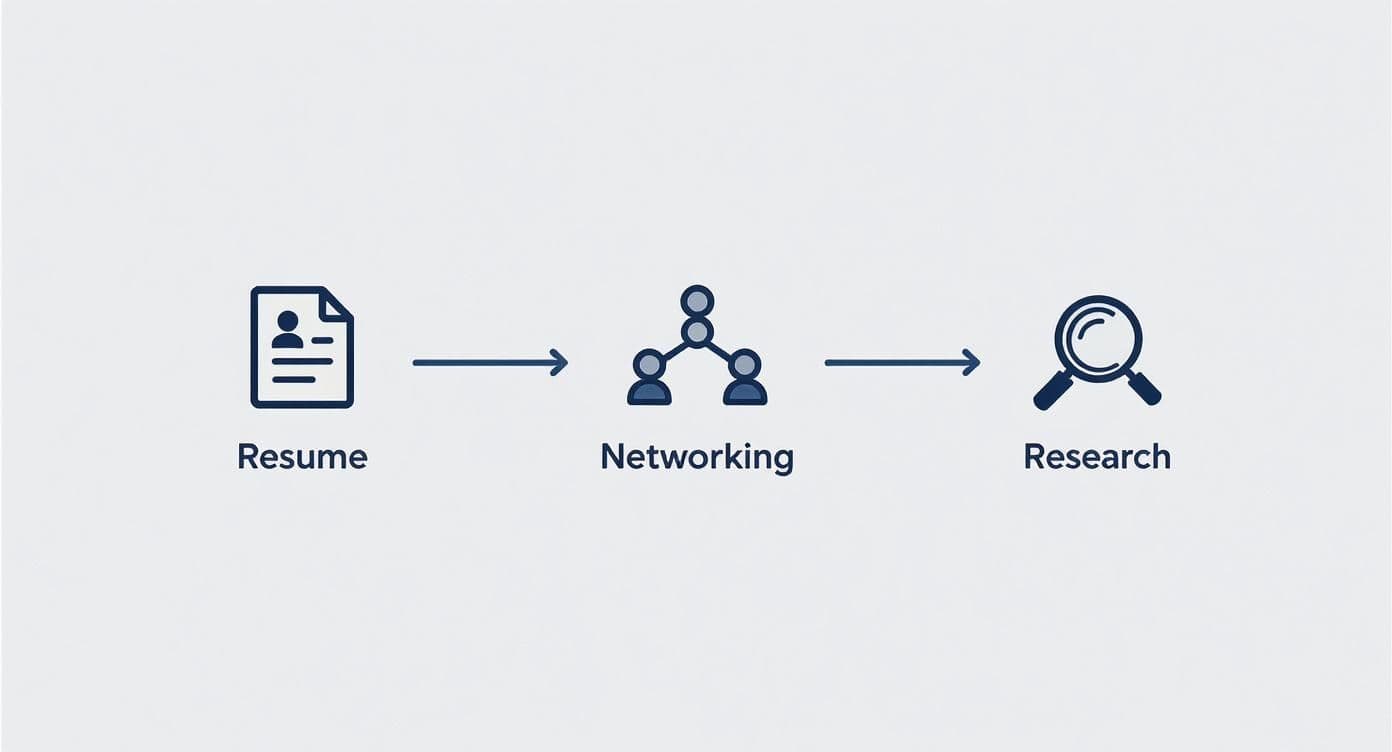
As you can see, your resume, networking, and research all work together. They build the foundation for your candidacy before you ever field a single technical question.
Nailing the Core Valuation Methods
At the heart of any technical interview, you'll find the three main valuation methodologies. You need to know these cold—not just the mechanics, but the subtle art of choosing one over the others.
- Comparable Company Analysis (Comps): This is all about valuing a company using the trading multiples of similar public companies. Get ready to defend your choice of comps based on industry, size, and geography. A classic question is, "Why is EV/EBITDA a better multiple than P/E for this specific industry?"
- Precedent Transactions: Here, you're valuing a business based on what acquirers paid for similar companies in past M&A deals. The crucial concept is the control premium—the extra amount a buyer pays to gain control. Expect to be asked, "Why do precedent transactions almost always yield higher valuations than comps?"
- Discounted Cash Flow (DCF): A DCF values a company based on the present value of its future cash flows. This is often viewed as the most "pure" valuation method, and it's where interviewers love to dig in. To really get this down, our guide on financial modeling best practices covers the techniques in detail.
A huge mistake I see candidates make is learning these methods in a vacuum. The best applicants can explain how all three valuations work together to form a "valuation football field" and intelligently discuss the reasons they might diverge.
Thinking About Accounting Like a Banker
You don't need to be a CPA, but you absolutely must have a rock-solid grasp of how the three financial statements link together. You will almost certainly be given a scenario and asked to walk an interviewer through its impact on the Income Statement, Balance Sheet, and Cash Flow Statement.
A classic example goes something like this: "A company writes down the value of its inventory by $10 million. Walk me through the 3-statement impact, assuming a 40% tax rate."
You have to be able to fluidly explain how the write-down hits the Income Statement, reduces Net Income, and then flows through the Cash Flow Statement (as a non-cash add-back) and the Balance Sheet (hitting both inventory and retained earnings). This is the language of finance, and fluency is non-negotiable.
Advanced Topics That Set You Apart
Once you've got the fundamentals down cold, it's time to work on the concepts that separate the top 1% of candidates. These are the topics you'll almost certainly see in second-round interviews and superdays.
To help structure your technical prep, think of it in terms of building from a foundational understanding to practical application.
Key Technical Concepts and Preparation Focus
| Technical Topic | What to Know (The Basics) | How to Prepare (The Application) |
|---|---|---|
| 3 Financial Statements | How they link together; the purpose of each statement (IS, BS, CFS). | Practice "walk me through" drills (e.g., impact of $10 of depreciation). |
| Valuation (Comps, Precedents) | The core mechanics; key multiples (EV/EBITDA, P/E). | Defend your choice of comps; explain control premiums. Articulate why multiples differ. |
| Discounted Cash Flow (DCF) | Unlevered vs. levered FCF; calculating WACC; terminal value. | Build a simple DCF from scratch in Excel. Be ready to justify every assumption. |
| Leveraged Buyout (LBO) | What makes a good LBO candidate; how leverage drives returns. | Walk through a "paper LBO" and calculate the IRR. Explain the main value drivers. |
| M&A Accretion/Dilution | The math behind combining companies; pro forma EPS calculation. | Practice quick mental math on whether a deal is accretive or dilutive. |
This table isn't just a checklist; it's a roadmap. Start by mastering "What to Know" and then spend most of your time practicing "How to Prepare." The application is what gets you the offer.
The bar has been raised. By 2025, the technical and behavioral demands of these interviews have intensified. Interviewers expect more than rote memorization; they want to see you apply financial theory to real-world problems and discuss recent market trends with genuine insight.
Ultimately, crushing the technical interview is about one thing: repetition. Drill these concepts until they become muscle memory. When you’re sitting in that high-pressure interview, your preparation will be what shines through.
Nailing the "Fit" Interview: Crafting Your Personal Narrative
 Getting through the technical gauntlet is one thing, but it’s your story that truly closes the deal. Investment banking is an old-school apprenticeship business. It’s built on grit, long hours, and high-stakes teamwork. When an interviewer sits across from you, they aren't just looking for an analyst. They're trying to figure out if they can stand being in a room with you for 80-100 hours a week.
This is exactly why behavioral questions are so critical. They’re designed to peel back the layers and see who you really are. Generic, canned answers just won't fly. You need a compelling, authentic narrative that makes you memorable for all the right reasons.
Deconstructing the “Big Three” Foundational Questions
Every single candidate absolutely must have polished, airtight answers for three core questions. Don’t think of these as simple icebreakers; they are fundamental tests of your self-awareness, motivations, and genuine interest in the role.
- "Walk Me Through Your Resume": This is not a verbal recitation of your CV. It's an invitation to tell your professional story. Your goal is to deliver a tight, 90-second to two-minute narrative. Connect the dots between your key experiences, explaining why you made certain moves and how each step logically led you to sit in that chair, interviewing for that specific role.
- "Why Investment Banking?": Your answer here needs to go far beyond the clichés. "I want to learn a lot" or "I enjoy finance" are instant disqualifiers. You have to demonstrate a real, tangible understanding of the job. Talk about what an analyst actually does—building models, running due diligence, working on deals that reshape industries—and connect those functions to your own skills and passions.
- "Why Our Firm?": This is the ultimate test of whether you've done your homework. A generic response about the bank's brand or league table ranking is a massive red flag. You need specifics. Did they just advise on a deal you followed? Do they have a particularly strong M&A group in a sector you’re passionate about? Mentioning something you learned from an informational chat with a current employee shows you’ve put in the work.
Go Beyond the Standard STAR Method
You've probably heard of the STAR method (Situation, Task, Action, Result). It’s a decent starting point for structuring your answers, but if you stick to it too rigidly, you’ll sound like a robot. The real goal is to tell a story, not just list facts.
A better way to think about it is STAR+L: Situation, Task, Action, Result, and Learning. What was the key takeaway? How did that experience shape your work ethic or your approach to teamwork?
Let’s say you’re asked about a time you handled a major challenge:
- Situation: "During my last internship, my team was up against a tight deadline building a valuation model for a client presentation."
- Task: "Just two days before the due date, we found a huge error in our primary data source, which completely invalidated our initial work."
- Action: "I took the lead, staying late to pull and scrub data from an alternative source. I then rebuilt the problematic sections of the model overnight and walked my team leader through the changes and their impact first thing in the morning."
- Result: "Because of that, we corrected the model and delivered an accurate valuation on time. The partner on the deal even commended our team’s diligence."
- Learning: "That situation drove home the importance of data integrity. It taught me to be proactive in communicating problems immediately instead of waiting, and it solidified my habit of triple-checking every critical input."
Adding that final "Learning" piece adds a layer of maturity and self-awareness that interviewers absolutely look for. While these examples are finance-focused, the storytelling principle is universal. You can explore this concept further in our guide to behavioral interview questions for consulting, where the emphasis on narrative is just as strong.
Build Your Library of Stories
You'll never be able to predict every single question, but you can prepare for every possible theme. The best way to do this is by creating a "story library." Before you walk into any interview, you should have three distinct success stories and three compelling failure/challenge stories locked and loaded.
Think of your story library as your strategic toolkit. Each story should be a Swiss Army knife—versatile enough to be adapted to answer questions about leadership, teamwork, failure, or attention to detail.
These stories don't have to come from a previous banking internship. In fact, some of the most memorable ones come from other parts of your life:
- High-pressure academic projects
- Leadership roles in campus clubs or organizations
- Demanding part-time jobs
- Experiences from competitive sports
The key is to choose experiences that clearly demonstrate the core traits every bank wants: analytical horsepower, an insane work ethic, collaborative spirit, and resilience under fire. With these narratives prepared, you can walk into any interview feeling confident, ready to share a story that shows exactly who you are and why you're the right person for their team.
Developing Your Market Awareness and Insight
Your technical skills and a polished resume will get you in the door. Your personal story might even get you to the final rounds. But what often separates the candidate who gets the offer from everyone else? Genuine market insight.
This is where you prove you don't just understand finance from a textbook. It’s about showing you live and breathe the markets. This demonstrates an intellectual curiosity and a deep-seated passion that simply can't be faked, turning a standard Q&A into a peer-level discussion. Anyone can repeat headlines; a top candidate connects the dots, forms an opinion, and articulates what a market event actually means for a company, an industry, or a potential deal.
Turning Information Into Intelligent Opinions
Make daily reading a non-negotiable habit. Sticking to sources like the Wall Street Journal, Financial Times, and key industry publications is the absolute baseline. The real skill, however, is weaving that information into sharp, defensible talking points you can use in an interview.
For example, when a major M&A deal hits the news, dig deeper than the headline price. Start asking the right questions:
- What’s the real strategy here? Are they trying to gobble up market share, buy some cool new tech, or muscle into a new country?
- What are the supposed synergies? Be skeptical. How realistic are the cost savings or revenue boosts the companies are promising their investors?
- How was it valued? Does the purchase multiple (like EV/EBITDA) make sense when you compare it to industry peers or other recent deals?
Walking into an interview with a thoughtful, structured opinion on two or three recent deals is a game-changer. It’s definitive proof that you’re actively engaged with the industry you claim to be so passionate about.
Building a Defensible Stock Pitch
A classic interview test for your analytical and communication skills is the stock pitch. This isn't about naming a hot tech stock you saw on social media. It's an exercise in building an investment thesis and defending it under pressure.
A great stock pitch is a story backed by numbers. You need to present a clear, compelling narrative for why a company is undervalued or overvalued, and then support that narrative with solid financial analysis.
Keep your pitch concise and well-structured. Kick it off with a clear recommendation (buy or sell), lay out your three core arguments, touch on valuation, and then—crucially—identify the biggest risks to your thesis.
Maybe you’re pitching a “buy” on a company because you believe the market is totally underestimating its pricing power in a niche segment. You’d need to back that up with data on market share, a quick competitor analysis, and a simple valuation showing the potential upside. This thought process uses some of the same logic involved in figuring out a company's potential, which you can explore in our guide on what is market sizing.
Navigating Unpredictable Recruiting Timelines
Finally, your market awareness has to extend to the recruiting world itself. The days of a rigid, predictable hiring calendar are long gone.
While investment banking hiring once followed a set rhythm, recent years have thrown that schedule out the window. Off-cycle hiring recently hit an unprecedented 45% of all recruitment as firms scrambled to fill unexpected gaps. This means you can't just cram for a single interview season. Your prep has to be a continuous process.
Stay ready, keep your skills sharp, and be prepared to jump on opportunities whenever they pop up. This kind of adaptability shows you have the resilience and proactive mindset that this demanding career requires. By staying plugged into deals, markets, and the recruiting environment itself, you signal a level of commitment that makes you a truly standout candidate.
Perfecting Your Performance with Mock Interviews

Knowing the theory behind a DCF model and having your story down cold are crucial, but they won't get you far if you can't deliver under pressure. This is where your investment banking prep shifts from simply learning things to actually training for performance. Mock interviews are your sparring sessions—they build the muscle memory you need to stay sharp when it really counts.
The goal isn't just to practice; it's to simulate the genuine, high-stakes feel of a final round interview. Recreating that pressure is the only way to find out where your weak points really are. It’s one thing to know an answer, but another entirely to articulate it clearly when you’re nervous and on the spot.
Structuring a High-Impact Mock Session
To get the most out of your practice, you have to treat it like the real deal. Find partners who will push you and give it to you straight—think peers from your university finance club, alumni working in banking, or even a professional interview coach. Don't waste your time practicing with friends who will be too nice to give you brutally honest feedback.
Once you’ve found your partner, structure the session to mirror an actual interview. Don’t just wing it with random questions. A realistic flow is key:
- Behavioral Deep Dive (15 mins): Kick things off with "Walk me through your resume," then dive into tough fit questions that probe your story and motivations.
- Technical Gauntlet (20 mins): Switch gears to rapid-fire technicals. Hit on accounting, valuation, and M&A concepts. Make sure to include at least one multi-step problem, like a 3-statement impact question.
- Market-Based Case (10 mins): Wrap up with a prompt like "Pitch me a stock" or "Talk me through a recent M&A deal you've followed."
This structure deliberately mimics the intensity of a superday, where you’re forced to shift between different ways of thinking on the fly. The average superday now involves 5–10 rounds, with each lasting 30–45 minutes and covering everything from your resume to complex case studies. It's a marathon designed to test your stamina, which makes realistic mock interviews an absolutely essential part of your prep. You can find more details on modern interview formats here.
Analyzing and Improving Your Performance
The most critical part of any mock interview happens after it’s over. Just going through the motions is a waste of time. You need a system for rigorous self-assessment. Record your sessions—video is best—and force yourself to watch them back. Pay close attention not just to what you say, but how you say it.
Your goal isn't just to survive a mock interview. It's to systematically identify every single weakness—from the filler words you use when you're nervous to the subtle hesitation before answering a valuation question—and then drill those weaknesses until they become strengths.
Create a simple spreadsheet to track how you did. Log the specific questions you struggled with and pinpoint why. Was the technical answer just wrong, or did you give the right answer but sound completely unsure of yourself?
Break down the feedback into actionable areas:
- Clarity and Conciseness: Did your "resume walk" drag on past the two-minute mark? Were your answers sharp and to the point?
- Technical Accuracy: Which concepts are still a bit shaky? Is it LBO mechanics? Accretion/dilution math?
- Delivery and Presence: How was your eye contact? Are you peppering your sentences with "um" or "like"?
After each session, isolate your single biggest problem area and dedicate your next study block entirely to fixing it. This focused, iterative approach is what turns practice into real progress, building the kind of polish and confidence that separates the candidates who get offers from everyone else.
A Few Common Questions About IB Interview Prep
Even with a rock-solid plan, prepping for an investment banking interview can feel like a marathon. It's natural for questions to pop up, and getting good answers is key to keeping your momentum.
Let's cut through the noise and tackle some of the most common questions I hear from candidates.
How Many Hours Should I Realistically Spend Prepping?
This is the big "it depends" question, but I can give you a solid baseline. Most people should plan for 80 to 120 hours of active preparation. I'm not talking about passively flipping through a textbook; this is time spent doing drills, mock interviews, and really wrestling with the material.
If you can, spread this out over two or three months. It gives the concepts time to sink in and helps you avoid burning out. Your starting point matters a lot, of course. A finance major who’s already done a banking internship might land on the lower end of that range. On the other hand, if you're switching careers from a totally different field, you'll probably need more time to build that technical foundation from scratch.
It's all about the quality of your prep, not just the raw hours. Ten focused hours spent on mock interviews will do more for you than 30 hours of zoning out while re-reading a valuation guide.
I'm From a Non-Target School. Is It a Deal-Breaker?
Absolutely not. But you do have to be scrappier and smarter about it. Students from "target schools" definitely have an easier path because of on-campus recruiting, but banks hire from all over. The key is understanding that your strategy has to be different.
If you're coming from a non-target school, you need to go all-in on two things:
- Networking Like Your Career Depends On It: You have to build your own connections. This means consistent, personalized outreach on LinkedIn to alumni and anyone else you can find in the industry. Your goal is to get on the phone for informational chats and find someone inside the bank who is willing to put your resume on the right desk.
- Being Technically Flawless: When you finally get that interview, you can bet the bar will be higher for you. You have to be incredibly sharp. Your answers to technical and behavioral questions need to be so good that they have no choice but to take you seriously.
What's the Single Biggest Mistake People Make?
Easy. It's underestimating the "fit" and behavioral side of the interview. So many candidates grind for hundreds of hours to master LBO models but can't tell a compelling story about themselves.
At the end of the day, bankers hire people they actually want to be stuck in a room with during those infamous 100-hour workweeks. You have to be able to explain "Why this firm?" and "Why banking?" with genuine conviction. If you can't, it doesn't matter how perfect your technicals are—you're not getting the offer.
Another classic mistake is sounding like you've just memorized a script. Interviewers can hear it a mile away. They aren't looking for a robot; they want to have a real conversation that shows you're smart, driven, and someone they can work with.
Ready to stop just practicing and start performing? Soreno provides an AI-powered platform with over 500 cases and drills tailored for finance interviews. Get instant, rubric-based feedback on your structure, communication, and technical skills from an MBB-trained AI interviewer. Start your 7-day free trial and build the confidence to land the offer.