
Acing the Numerical Reasoning Assessment in Consulting and Finance
Master the numerical reasoning assessment with this expert guide. Get practical strategies, solved examples, and insights for your finance or consulting career.

So, you've been asked to take a numerical reasoning assessment. Your first thought might be, "Great, a math test." But that's not quite what these are about. Think of it less like a final exam and more like a simulation of the real-world quantitative thinking you'll do on the job.
It’s not designed to test your knowledge of advanced calculus or abstract algebra. Instead, it measures your ability to interpret and analyze numerical data—charts, tables, percentages—to make solid, logical decisions, usually under a tight time limit.
Cracking the Code of Numerical Reasoning Assessments

Imagine a chef who can take a handful of simple ingredients and turn them into a spectacular dish. A numerical reasoning assessment tests a similar skill: your ability to take raw data—sales figures, market trends, or operational metrics—and cook up valuable business insights. It’s all about practical application under pressure, not reciting formulas from memory.
Top-tier firms in consulting, investment banking, and private equity lean heavily on these tests for one simple reason: they work. They serve as a powerful filter, helping to identify candidates who have the quantitative agility needed for high-stakes roles. The day-to-day work in these fields, whether it's M&A analysis, market sizing cases, or profitability deep dives, requires you to think critically with numbers to solve messy business problems.
Why These Tests Are a Gateway to Elite Careers
The demand for professionals with sharp analytical skills is only getting stronger. The global Numerical Reasoning Test (NRT) market was valued at USD 799.2 million in 2024 and is projected to climb to USD 1,500 million by 2035—a steady growth rate of 5.9%. This trend highlights just how embedded these tests have become in the hiring playbook, especially as firms like McKinsey, BCG, and Goldman Sachs use them to vet thousands of applicants. You can dig deeper into these market trends in the full report.
For these companies, a candidate's score is a reliable predictor of their on-the-job performance. It signals that you can:
- Quickly make sense of dense financial reports or client data.
- Spot the critical trends and patterns hidden in charts and graphs.
- Formulate logical, data-driven recommendations under a time crunch.
- Communicate quantitative ideas clearly and confidently.
When you're faced with a numerical reasoning test, employers aren't just looking for a score. They're trying to understand the core skills you bring to the table. The table below breaks down what they're really measuring.
Core Skills Measured in a Numerical Reasoning Assessment
| Skill Category | What It Really Means | Application in Consulting or Finance |
|---|---|---|
| Data Interpretation | Can you look at a table or chart and instantly understand the story it's telling? | Quickly sizing a market from a data table during a case interview or finding the key takeaway in a client's financial statement. |
| Numerical Logic | Can you identify relationships, patterns, and trends in a sea of numbers? | Spotting an unusual dip in quarterly sales and connecting it to a competitor's product launch, all from a single spreadsheet. |
| Calculation Speed & Accuracy | Are you fast and precise with basic math (percentages, ratios, currency conversions)? | Calculating a company's EBITDA margin on the fly during a meeting or running "back-of-the-envelope" math to sanity-check a model. |
| Problem-Solving | Can you use the provided data to answer a specific business question, ignoring irrelevant noise? | Using client data to determine which product line to discontinue or which market to enter next, all based on the numbers provided. |
Ultimately, what these tests assess is your readiness to tackle the quantitative challenges that are central to roles in finance and consulting.
In essence, a numerical reasoning assessment isn’t just another hoop to jump through. It is your first opportunity to demonstrate the analytical horsepower and clear-headed thinking that define a successful career in finance or consulting.
Mastering this test is about proving you can handle the intense quantitative demands of the job from day one. It positions you as a candidate who doesn't just see numbers, but understands the story they tell.
Decoding Common Test Formats and Question Types

When you sit down for a numerical reasoning test, the last thing you want is a surprise. Knowing how to do the math is only half the battle; the other half is understanding the specific format the employer has chosen. Each one is designed to test a slightly different aspect of your analytical skills, usually under serious time pressure.
Knowing what you're walking into is a game-changer. It means you can spend your valuable mental energy solving problems, not trying to figure out the rules on the fly.
The Three Core Test Structures
Most numerical tests you’ll face will fall into one of three common formats. Getting familiar with them is your first strategic advantage.
-
Timed Sprints: This is the classic format. Picture getting 20 questions in 20 minutes. The clock is your biggest opponent, and the test is designed to measure how quickly and efficiently you can work. It’s not just about getting the right answer; it’s about getting it fast and moving on.
-
Calculator vs. No-Calculator: This single rule completely changes the game. If you have a calculator, expect more complex numbers and problems with multiple steps. If you don't, the focus shifts to your mental arithmetic—how sharp and accurate are you without a safety net?
-
Adaptive Testing: This is a more modern, dynamic approach. The test actually adjusts to your skill level in real-time. Answer a question correctly, and the next one gets a bit tougher. It's a very efficient way for employers to pinpoint your exact proficiency level.
The bottom line is that every numerical test is a blend of skill and strategy. Knowing the format helps you set the right pace and choose the best approach for the problems you're facing.
Mastering the Four Key Question Archetypes
Beyond the test's structure, the questions themselves follow predictable patterns. Once you learn to spot these "archetypes," you can stop reinventing the wheel on every problem and instead apply a tried-and-true method to get to the answer.
You’ll almost always run into these four types:
-
Table and Chart Interpretation: This is the bread and butter of numerical reasoning. You'll get a screen full of data—bar charts, dense tables, line graphs—and be asked to pull out key information. The real skill here is quickly filtering out all the irrelevant "noise" to find the one or two numbers that actually matter.
-
Percentage Changes and Calculations: Get comfortable with percentages. You'll be asked to calculate increases, decreases, profit margins, and market share. A typical question sounds like, "What was the percentage growth in sales for the European division from 2022 to 2023?"
-
Ratios and Proportions: These questions are all about understanding the relationship between different numbers. You might be asked to simplify a ratio, solve for a missing piece of a proportion, or apply a ratio to a larger data set. If you’re dealing with business data, having a good financial ratios cheat sheet handy during your practice can make a big difference.
-
Currency and Unit Conversions: Especially common in tests for global firms, these questions will have you switching between currencies or different units of measurement (like converting from barrels to gallons or euros to dollars). The key is precision—using the right conversion factor is non-negotiable.
While these all seem like math problems, they're also a subtle test of your logical thinking. It’s a skill that has a lot in common with what’s measured in a https://soreno.ai/articles/deductive-reasoning-test. Learning to spot these question patterns is the first step in turning a wall of data into a straightforward problem to solve.
Practice Questions with Step-by-Step Solutions
Knowing the theory is one thing, but applying it when the clock is ticking is another beast entirely. The single best way to get ready for a numerical reasoning test is to get your hands dirty with problems that feel just like the real thing.
Think of it like a pilot in a flight simulator. Those hours of practice build the muscle memory needed to perform flawlessly when it counts. In this section, we'll walk through a few common question types. We won't just give you the answers; we'll break down the entire thought process, from figuring out what the question really asks to doing the math quickly.
Question 1: Data Table Interpretation
Let's kick things off with a classic: pulling insights from a data table. These questions are designed to test how quickly you can find the right numbers in a sea of information and then do something meaningful with them.
Scenario: The table below shows the quarterly revenue (in millions USD) for three different product lines at a technology company in 2023.
| Product Line | Q1 Revenue | Q2 Revenue | Q3 Revenue | Q4 Revenue |
|---|---|---|---|---|
| Software | $12.5 | $14.0 | $15.2 | $17.8 |
| Hardware | $25.0 | $22.5 | $21.0 | $28.0 |
| Services | $8.0 | $8.5 | $9.5 | $10.0 |
Question: Which product line experienced the highest absolute revenue growth from Q1 to Q4?
Step-by-Step Solution:
- Pinpoint the Goal: The keyword here is “absolute revenue growth,” not percentage growth. This is a common trap! We just need to find the simple dollar difference between Q4 and Q1 revenue for each product.
- Calculate for Software:
- Q4: $17.8 million
- Q1: $12.5 million
- Growth = $17.8M - $12.5M = $5.3 million
- Calculate for Hardware:
- Q4: $28.0 million
- Q1: $25.0 million
- Growth = $28.0M - $25.0M = $3.0 million
- Calculate for Services:
- Q4: $10.0 million
- Q1: $8.0 million
- Growth = $10.0M - $8.0M = $2.0 million
- Compare and Conclude: Laying out the growth numbers—$5.3M, $3.0M, and $2.0M—makes the winner obvious. The Software line had the highest absolute growth.
Answer: Software
These questions are all about precision under pressure. The most frequent mistake is glossing over the prompt and calculating percentage change by mistake. Always read the question twice.
Question 2: Percentage Change Problem
You will absolutely see percentage change questions. They are a staple of numerical tests because they’re fundamental to business analysis, whether you're looking at sales figures, market share, or investment returns.
Scenario: A retail company's online sales were $450,000 in 2022. In 2023, the online sales increased to $585,000.
Question: What was the percentage increase in online sales from 2022 to 2023?
Step-by-Step Solution:
- Remember the Formula: The go-to formula is
((New Value - Old Value) / Old Value) * 100. - Find the Raw Increase: First, let's get the simple difference in sales.
- Increase = $585,000 - $450,000 = $135,000
- Divide by the Original Value: Now, we divide that increase by the starting point (the 2022 sales).
- $135,000 / $450,000
- Simplify for a Mental Shortcut: Don't reach for the calculator just yet. Notice you can knock the zeros off and work with
135 / 450. A quick glance shows both are divisible by 45.135 / 45is 3, and450 / 45is 10. That simplifies the whole thing down to a clean 3/10. - Convert to a Percentage: The fraction 3/10 is simply 0.3. Multiply by 100 to get your percentage.
- 0.3 * 100 = 30%
Answer: 30%
The real skill here is finding those shortcuts. Instead of punching large, clunky numbers into a calculator, simplifying the fraction to
3/10makes the final calculation instant. Those saved seconds are gold on a timed test.
For more hands-on problems and strategies, you can find a wealth of resources in our complete guide to numerical reasoning test practice.
Question 3: Multi-Step Analysis
Now for the complex ones. Multi-step problems roll several skills into a single question. You have to read carefully, pull data, perform a few different calculations, and then combine the results to get your final answer. They’re meant to simulate real-world business challenges.
Scenario: A company produces two products, Alpha and Beta. In a given month, the company produced 4,000 units of Alpha and 6,000 units of Beta. The production cost for Alpha is $15 per unit, and for Beta, it is $20 per unit. 10% of Alpha units and 5% of Beta units were found to be defective and could not be sold.
Question: What was the total cost of the defective units produced in that month?
Step-by-Step Solution:
- Map Out the Problem: Okay, we need to find the cost of defective units for each product and then add them together. Let's tackle them one by one.
- Calculate Defective Alpha Units:
- Total Alpha Units: 4,000
- Defective Rate: 10%
- Defective Units = 4,000 * 0.10 = 400 units
- Find the Cost of Defective Alpha Units:
- Cost per unit: $15
- Total Cost = 400 units * $15/unit = $6,000
- Calculate Defective Beta Units:
- Total Beta Units: 6,000
- Defective Rate: 5%
- Defective Units = 6,000 * 0.05 = 300 units
- Find the Cost of Defective Beta Units:
- Cost per unit: $20
- Total Cost = 300 units * $20/unit = $6,000
- Calculate the Grand Total: Now, just add the two costs together.
- Total Cost = $6,000 (from Alpha) + $6,000 (from Beta) = $12,000
Answer: $12,000
How Top Firms Really Look at Your Score
So you've submitted your numerical reasoning test. You take a deep breath, and for you, it's over. But on the employer's side, the process is just getting started. Your raw score—how many questions you got right—is just the first piece of the puzzle. For the firms you want to work for, that number is immediately translated into something much more powerful: a percentile ranking.
This is crucial. Your performance isn't being graded in a vacuum. It's being compared against a huge pool of other ambitious candidates who have taken the exact same test. If you land in the 85th percentile, it means you out-scored 85% of your peers. That context changes everything.
It’s Not About Passing, It's About Standing Out
When you're applying to elite management consulting or investment banking firms, the competition is fierce. "Good enough" just doesn't cut it. These companies aren't looking for people who can simply pass; they're looking for outliers who excel.
Most of these firms set incredibly high benchmarks, typically screening for candidates who score in the top 10% to 20% of all test-takers. Think about what that means. The firm isn't just asking, "Can this person work with numbers?" They're asking, "Is this person better with numbers than thousands of other highly intelligent, motivated applicants?" Your score is the data point that decides whether your application gets a serious look or is filtered out before a human ever sees your resume.
A top-tier numerical reasoning score is your non-negotiable ticket through the first gate. It's proof that you have the raw quantitative horsepower needed for the intense analytical work that defines these roles.
Why This One Test Carries So Much Weight
It's easy to dismiss these tests as just another hoop to jump through, but that's a mistake. The skills being measured aren't abstract academic problems; they are a direct preview of the tasks you'll be doing every single day in these high-stakes jobs.
Consider the core work in these fields:
- Building a Financial Model: An investment banking analyst has to rip through financial statements, calculate growth rates on the fly, and project future performance—all with extreme precision. This is exactly what percentage change and data interpretation questions are testing.
- Evaluating an M&A Deal: A private equity associate needs to quickly make sense of a target company's performance by digging through a data room, spotting trends, and identifying red flags. That’s the same skill you use to analyze complex charts and tables under a ticking clock.
- Creating a Market Sizing Model: A consultant is constantly making logical assumptions and running "back-of-the-envelope" calculations to figure out how big an opportunity is. This requires the same mental math and problem-solving agility you build while prepping for the test.
This direct connection is why firms put so much faith in these assessments. How well you perform is a powerful signal of how well you'll perform on the job. Plus, these objective screens are proven to work. A 2022 study from SHRM found that companies using these tests saw 23% more diverse hires, helping them find top analytical talent from all backgrounds. You can read more on how these tests impact recruitment market trends.
At the end of the day, a numerical reasoning test is far more than just a hurdle. For a top firm, it's a predictive tool. For you, it's your first chance to prove you have what it takes. Honing these skills isn't just about passing a test; it's a foundational step for anyone serious about a career in high-stakes finance, a journey we detail in our guide to investment banking interview preparation.
Your 4-Week Study Plan for Peak Performance
Scoring in the top percentile on a numerical reasoning test isn't about mindlessly grinding through practice questions. It’s about smart, structured preparation. The real key is moving from just "practicing more" to "practicing smarter."
Think of a solid study plan as your roadmap. It guides you from shaky fundamentals to complete test-day confidence, ensuring you spend your time shoring up weaknesses instead of just randomly tackling problems. This is how you build the skill—and the calm—to perform when it counts.
Your 4-Week Numerical Reasoning Study Schedule
Here's a sample study plan to take you from foundational skills to full-blown test readiness. You can adjust the time commitments based on your schedule, but try to stick to the weekly focus to build skills progressively.
| Week | Focus Area | Key Activities and Drills | Time Commitment |
|---|---|---|---|
| 1 | Foundations: Mental Math & Data Fluency | Daily 15-minute drills on mental arithmetic (no calculator), percentage/fraction conversions, and quick estimation. Familiarize yourself with common chart and table formats. | 3-4 hours |
| 2 | Skill Building: Question Types | Focus on specific question types you find difficult (e.g., ratios, currency conversions, percentage change). Work through untimed practice sets to master the methodology first. | 4-5 hours |
| 3 | Speed & Accuracy: Timed Drills | Start doing timed practice sections. Simulate test conditions—set a timer for 60 seconds per question and stick to it. Begin your error analysis log. | 5-6 hours |
| 4 | Test Simulation & Review | Take 2-3 full-length, timed mock exams. Dedicate significant time to reviewing every single mistake. Do a final brush-up on mental math and formulas. | 5-6 hours |
This schedule is designed to build momentum. Each week's focus layers on top of the last, turning weak points into strengths and transforming raw knowledge into applied skill under pressure.
Phase 1: Building Your Foundational Skills
The first week is all about sharpening the tools you'll use on every single question: mental math and data familiarity. Nailing these fundamentals saves you precious seconds on the clock, which adds up to a huge advantage when you hit the more complex, multi-step problems.
Kick things off with daily drills for just 15-20 minutes.
- Mental Arithmetic: Force yourself to do addition, subtraction, multiplication, and division with multi-digit numbers without reaching for a calculator.
- Percentage & Fraction Conversions: You must be able to instantly convert common fractions (1/8, 3/4, 2/5) to percentages and decimals. This is non-negotiable for most tests.
- Estimation Practice: Look at a messy calculation like 4,892 x 0.26 and practice approximating the answer. This skill helps you immediately eliminate answer choices that are way off the mark.
Getting these basics down also requires deep concentration. If you find your mind wandering, it’s worth exploring techniques to improve focus at work, as the same principles apply here.
Phase 2: Advanced Application and Simulation
With a solid foundation, it’s time to apply those skills under the pressure of the clock. This is where you move from isolated drills to full-on test simulation. The goal is to mimic the real assessment as closely as possible to build stamina and master your pacing.
From this point on, always use a timer. If the test gives you 20 minutes for 20 questions, you need to train yourself to that one-minute-per-question rhythm. This builds an internal clock, teaching you when a tough question is becoming a time sink and it’s time to move on.
The most critical part of this phase is analyzing your mistakes. After each timed test, don't just glance at your score. Create an "error log" for every question you got wrong. Note the question type and, more importantly, why you missed it. Was it a simple calculation error? A misinterpretation of the graph? Or did you just run out of time?
This kind of systematic review uncovers patterns you’d otherwise miss. If you realize you’re consistently fumbling ratio problems, you know exactly what to drill in your next session.
Here’s a look at what happens behind the scenes after you hit "submit" on your assessment.
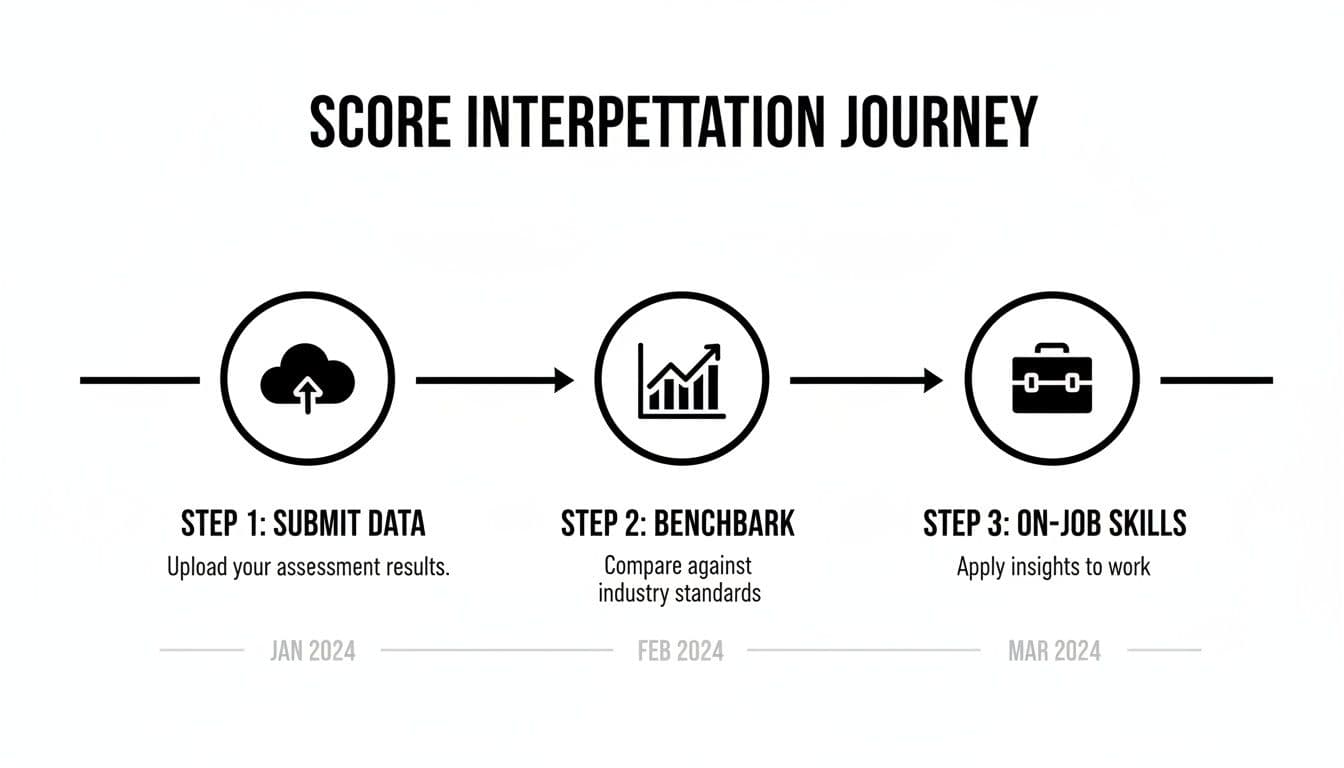
As you can see, your raw score is first benchmarked against other candidates, then used to predict your aptitude for on-the-job skills. This is why companies value these tests so highly. They aren't just academic exercises; they're seen as powerful predictors of success in data-driven roles.
Common Mistakes to Avoid During the Test
Knowing what trips people up is half the battle. You can practice for weeks, but simple mistakes made under the pressure of the clock can torpedo an otherwise great performance. Think of this as your pre-flight checklist—the stuff you review to make sure you don't make an unforced error when it counts.
Let's walk through the most common traps I've seen candidates fall into, and more importantly, how you can sidestep them.
Misreading the Question in a Rush
This is, without a doubt, the number one reason people get questions wrong. It's so easy to do. You glance at a chart, grab the first numbers that look right, and dive into a calculation. Then, you realize—far too late—that you calculated profit when the question asked for revenue, or you found the percentage change when it wanted the absolute difference.
The fix is simple but requires discipline: read twice, calculate once. Seriously. Read the question, take a breath, and then read it again. On that second pass, actively hunt for the specific instruction. Is it asking "which product" or "what year"? Is it "increase" or "decrease"? This tiny habit will save you a world of frustration.
Getting Bogged Down on One Hard Problem
Every one of these tests has a few landmines—questions designed to be time-sucks. They might involve a bunch of steps or use deliberately tricky wording. The biggest mistake you can make is letting your pride take over, stubbornly wrestling with a single problem for three minutes while five easier questions go unanswered.
You need an exit strategy. I recommend the 90-second rule. If you don’t have a clear path to the answer after a minute and a half, it’s time to move on. Make your best-educated guess, flag it for review if you can, and bank the time for questions you can solve. Your mission is to get the highest score possible, not to prove you can solve the hardest problem.
Remember, a numerical reasoning assessment isn't just a math test. It’s a test of how you manage your time and think strategically under pressure. Getting stuck is a failure of strategy, not of intelligence.
Making Preventable Calculation Errors
When you're racing against the clock, it's amazing how easily silly mistakes creep in. You might hit a 7 instead of an 8 on the calculator, misplace a decimal point, or just flub a simple bit of mental math. These little slip-ups will cost you points just as surely as not knowing the formula.
Here are two solid ways to protect yourself from these errors:
- Write It Down: Even with a calculator, get in the habit of scribbling your main numbers and the structure of your calculation on scratch paper. This gives you a visual breadcrumb trail to double-check if your result looks off or doesn't match an answer choice.
- Do a Quick "Sanity Check": Before you click that final answer, take one last look at the numbers. Does your answer feel right in the context of the data? If sales were $50 million last year, and your calculation shows a new total of $500 billion, you've likely made a decimal error. This quick gut check can catch a surprising number of mistakes.
Answering Your Lingering Questions
Even with the best study plan, a few questions can still rattle around in your head. Let's clear those up right now so you can walk into your assessment feeling confident and ready, not anxious.
Here are the answers to the questions I hear most often from candidates.
How Much Math Do I Really Need to Know?
This is the big one, and the answer usually comes as a relief: you don't need advanced calculus or complex algebra. These tests aren't about your ability to recall abstract formulas from a math class you took years ago.
Instead, they're focused on the kind of practical, business-focused math you'd actually use on the job.
- Percentages and Ratios: Think about calculating market share, profit margins, or year-over-year growth.
- Fractions and Decimals: You'll need to be comfortable moving between them without a second thought.
- Basic Arithmetic: Speed and accuracy in addition, subtraction, multiplication, and division are your bread and butter.
- Data Interpretation: This is crucial. Can you look at a dense chart and quickly pull out the exact piece of information you need?
The real challenge isn't the difficulty of the math. The true test is whether you can apply these fundamentals quickly and accurately to solve business problems while the clock is ticking.
Can I Use a Calculator?
The classic "it depends." Some test providers, like SHL or Pymetrics, will give you a basic on-screen calculator. Others will forbid it entirely because they want to see how sharp your mental math is.
The most important thing you can do is confirm the rules for your specific test before you start practicing. A calculator changes everything. My advice? Train for both scenarios. Getting fast at mental math gives you an edge even when you do have a calculator.
What’s a Good Score, Anyway?
Forget thinking about a "good score" as a specific number of correct answers. It's all about how you stack up against other people. Employers use percentile scores to see where you land in the candidate pool.
For the most competitive jobs in consulting, finance, or private equity, you’re typically aiming to land in the 80th or 90th percentile. That means you need to perform better than 80-90% of the other candidates taking the same test. Your goal isn't just to be correct; it's to be more accurate and efficient than your competition.
How Is This Different from the GMAT or GRE?
While they both involve numbers, they're built for completely different purposes. The GMAT and GRE are academic tests, designed to predict success in a graduate school program. They cover a much broader, more theoretical range of math concepts.
A numerical reasoning assessment, on the other hand, is a job simulation. It's a vocational tool designed to see if you have the practical quantitative skills needed for a specific role. The questions are always wrapped in a business context—analyzing sales reports, interpreting market data, or comparing financial statements. It's about making smart decisions with data, not just solving a math problem.
Ready to turn preparation into peak performance? Soreno offers an AI-powered platform with guided drills and pinpointed feedback to master the quantitative skills top firms demand. Start your free trial today and practice with an MBB-trained AI interviewer at https://soreno.ai.