
What Are Case Interviews: what are case interviews? A Quick Path to Success
Curious what are case interviews? Discover formats, the essential skills, and a proven plan to land a top consulting offer.

So, what exactly is a case interview? It's a simulated business problem you solve live with your interviewer, almost like a miniature consulting project. Instead of just answering questions about your resume, you’ll be asked to tackle a complex business challenge—think figuring out why profits are down or whether a company should enter a new market—and come up with a sound recommendation.
The real point isn't to test what you already know, but to see how you think.
Your First Look At The Case Interview

Forget the intimidating reputation. The easiest way to think about a case interview is as a collaborative conversation centered around a business puzzle. Your interviewer isn't trying to trick you; they’re more like a guide, there to provide data, answer questions, and see how you approach the problem.
A great analogy is a doctor diagnosing a patient. A doctor doesn't just guess the illness. They ask clarifying questions, form a hypothesis, run a few tests, and then recommend a treatment plan. That same logical progression is exactly what you do in a case interview, just with business problems instead of medical ones.
This interactive format gives companies a window into skills a resume or a standard interview simply can't capture. They get to see your problem-solving abilities in real-time.
The Core Purpose of a Case Interview
At its heart, the case interview is a practical test drive. Consulting firms use it to see if you have the raw skills needed to be a great consultant from day one. It's less about memorizing business theories and much more about applying logic and structure, especially under a bit of pressure.
To give you a clearer idea, here is a quick breakdown of what a case interview typically involves.
The Case Interview At A Glance
This table breaks down the core components of a typical case interview, providing a quick reference for what you can expect.
| Component | What It Is | What It Tests |
|---|---|---|
| The Prompt | The interviewer presents a short business scenario or problem. | Your ability to listen, synthesize information, and ask clarifying questions. |
| Structuring | You create a logical framework to break down the problem. | Structured thinking and your ability to create a clear plan of attack. |
| Analysis | You ask for specific data and perform calculations to test your hypotheses. | Analytical rigor, quantitative skills, and your comfort with numbers. |
| Synthesis | You pull together all your findings into a coherent story. | Your ability to see the "so what?" behind the data and form insights. |
| Recommendation | You deliver a final, actionable recommendation based on your analysis. | Communication skills and your ability to be persuasive and confident. |
As you can see, each stage is designed to evaluate a different but critical consulting skill.
Key abilities being assessed include:
- Structured Thinking: Can you break down a massive, messy problem into smaller, manageable parts?
- Analytical Rigor: Are you comfortable with numbers? Can you dig into data to find the story it's telling?
- Business Acumen: Do you have a natural curiosity about how companies work and what makes them successful?
- Communication Skills: Can you walk someone through your thought process clearly and persuasively?
The goal isn't to find the one "right" answer. Instead, the focus is on the clarity and logic of your journey from the initial problem to your final recommendation. It’s the process, not just the solution, that truly matters.
Why Case Interviews Are So Common
Case interviews are the industry standard for recruitment at top consulting firms like McKinsey, BCG, and Bain. For most management consulting roles, you can expect to go through two to four case interviews over several rounds. It’s a rigorous process, but it helps firms find candidates with the sharp analytical minds needed for demanding client work.
Ultimately, getting good at case interviews is about developing a specific mindset. It’s a shift from academic learning to practical problem-solving, where you prove you have what it takes to tackle complex challenges. To learn more, check out our in-depth guide on the role of the case interview in management consulting.
Decoding The Different Case Interview Formats
Not all case interviews are cut from the same cloth. Just like a doctor uses different tools to diagnose different symptoms, consulting firms have a whole toolkit of case formats to test specific skills. Getting a handle on these different types is crucial, because your game plan will have to change depending on what they throw at you.
Think of it like learning the rules for different board games. The ultimate goal is always to win (or, in this case, impress the interviewer), but you wouldn't use a Monopoly strategy to play chess. This guide will walk you through the landscape.
Interviewer-Led vs. Interviewee-Led Cases
The first, and most important, distinction you need to understand is who's in the driver's seat. The dynamic between you and the interviewer dictates who steers the conversation, and it completely changes your approach.
-
Interviewee-Led (Candidate-Led) Cases: This is the classic format you'll find at firms like BCG and Bain. After the interviewer gives you the prompt, they mostly step back. It’s your job to build the roadmap—your framework—and then drive the analysis by asking for the specific data you need. You're steering the ship, deciding which leads to follow.
-
Interviewer-Led Cases: This is McKinsey's signature style. It feels much more like a structured, back-and-forth conversation. The interviewer guides you through a series of specific, targeted questions. Instead of creating one big framework upfront, they’ll ask things like, "What are three key risks in this market?" and once you've answered that, they'll lead you to the next piece of the puzzle.
Knowing this difference is non-negotiable. Walking into a McKinsey interview with a BCG-style, interviewee-led approach is one of the most common—and fatal—mistakes candidates make. You can dig deeper into this specific style by checking out our guide to mastering practice cases for McKinsey.
This is just the starting point. Firms use a few different formats to get a well-rounded view of a candidate. The main types you'll see are interviewee-led, interviewer-led, written cases, and group cases. This variety shows how seriously firms take evaluating candidates from every possible angle. If you're curious about the numbers, you can discover more insights about case interview statistics on managementconsulted.com.
Common Business Problem Types
Beyond the conversational dynamic, cases are always built around a specific business problem. If you can quickly identify the type of problem, you can pull the right tools and frameworks from your mental toolkit much faster.
Here are the greatest hits you'll see time and time again:
-
Profitability: The quintessential case. A company is losing money or profits are down, and you have to figure out why. This is all about breaking the problem down into its core components—revenues and costs—to hunt down the root cause.
-
Market Sizing: These questions are designed to test your logic and comfort with numbers. Think "How many electric scooters could be sold in Chicago next year?" You won't know the answer, but you'll be expected to make logical assumptions and do some quick math to arrive at a reasonable estimate.
-
Market Entry: A client is thinking about jumping into a new market or launching a new product. Your job is to advise them on whether it's a good idea. You'll need to look at everything from the market size and competition to whether the client even has the chops to pull it off.
-
Mergers & Acquisitions (M&A): One company wants to buy another. You have to play investment banker and consultant at the same time, assessing the target company's value, figuring out if there are any real synergies, and deciding if the deal makes strategic sense.
Below is an example from the Soreno platform. It shows how a candidate might start structuring a market sizing problem during an AI-powered practice session.
This screenshot captures that critical first step where you get the prompt and have to start mapping out your plan of attack—a core skill tested in every single case format.
Less Common and Specialized Formats
While you're less likely to run into these, firms sometimes throw a curveball to see how you handle different situations. It pays to be ready.
-
Written Cases: Instead of a conversation, you're handed a thick packet of documents, charts, and data. You'll get a couple of hours to sift through it all and prepare a slide deck with your recommendation. This is a direct test of your ability to synthesize a ton of information and build a clear, persuasive argument on paper.
-
Group Cases: The rarest of them all. You’ll be put in a room with a few other candidates and asked to solve a problem together. The interviewers are watching from the sidelines, assessing how you collaborate, contribute, and lead in a team setting. It’s a pure test of your people skills under pressure.
Getting familiar with all these formats gives you a mental map. When the interview starts, you'll be able to quickly identify the challenge you're up against and instantly adapt your strategy to match.
What Interviewers Are Really Looking For
So, you’re in the hot seat for a case interview. It’s easy to get tunnel vision, believing your entire goal is to hunt down that one "right" answer. But that’s a rookie mistake. The truth is, there often isn’t a single correct solution.
What your interviewer really cares about is how you get to your answer. They’re trained to watch your process, step-by-step, to see if you have the core skills that make a great consultant.
Think of it like this: a master chef isn't just tasting a student's final dish. They're watching the knife work, how the station is organized (mise en place), the seasoning technique, and especially how the student reacts when a sauce burns. Your thought process is your technique, and the interviewer is watching every move you make.
Structured Thinking: Your Logical Blueprint
First and foremost, they're looking for structured thinking. Can you take a massive, ambiguous business problem and break it down into smaller, manageable chunks? It's all about creating a clear, organized roadmap instead of just throwing random ideas at the wall.
An unstructured candidate might jump around: "Maybe their marketing is off? Or is the product too expensive?" In contrast, a structured thinker lays out a plan: "To figure out why profits are down, I want to start by looking at revenues, then I'll move to costs. Under revenues, we can break it down into price and volume. For costs, we can analyze fixed versus variable expenses." See the difference? You’ve just created a logical map for the entire conversation.
Quantitative Acumen: Beyond Basic Math
Next up is quantitative acumen. This is more than just being able to do math in your head. It’s about being comfortable with numbers and using them to push your analysis forward. Can you quickly size a market, calculate a break-even point, or pull a key insight from a chart?
Interviewers want to see you use numbers to test your hypotheses and build a data-driven argument. We’re not talking about complex calculus here—it’s practical business math, done with accuracy and confidence. For instance, quickly realizing that a 5% drop in volume hits the bottom line harder than a 10% jump in fixed costs shows you can connect the numbers to what actually matters in business.
Business Insight: Connecting the Dots
That skill ties directly into business insight, sometimes called business acumen. This is your ability to explain what your analysis means in the real world. A calculation is just a number until you explain the "so what?" behind it.
A candidate with strong business insight doesn't just say, "Costs are up by 15%." They dig in: "This 15% increase seems to be driven by raw materials. Is this hitting the whole industry, or are our supplier contracts just not as good as our competitors'?" That kind of question shows a much deeper level of commercial awareness.
Communication and Poise: Presenting with Confidence
Finally, none of this matters if you can't communicate it well. Interviewers are constantly evaluating your communication and poise. Can you walk them through your thought process clearly and concisely? When you get to the end, can you present your recommendation with conviction, even when you're under pressure?
This also includes your "coachability." Are you listening to the interviewer’s hints and adjusting your approach based on their feedback? The whole interview is a simulation, and it’s a high-stakes one. With offer rates for interviewed candidates often around 38-40%, showcasing these skills is how you stand out. You can get a better sense of how competitive the consulting recruitment cycle can be on caseinterview.com.
Ultimately, the interviewer is asking themselves a simple question: "Would I put this person in front of my client?" Hitting these four marks is how you get them to a confident "yes."
A Step-By-Step Case Interview Walkthrough
Alright, let's pull back the curtain and walk through a classic case interview, moment by moment. Theory is great, but seeing it in action is what makes it click.
Imagine you’re sitting across from the interviewer, and they hit you with this: "Our client is a national coffee shop chain. For the first time in five years, their profits are down. They want us to figure out why and what they should do about it."
This is a bread-and-butter profitability problem. Your goal isn't to magically guess the right answer. It’s to show them how you think by building a logical path to a solution. Let's break down how a top candidate would handle this.
Stage 1: Clarify The Problem
Your first instinct might be to start brainstorming, but that’s a rookie mistake. The first thing you do is pause. Take a breath. And then, ask smart questions. This shows you’re deliberate and methodical, not someone who shoots from the hip.
Your Inner Monologue: Okay, profitability. That’s just Profit = Revenue - Costs. But the prompt is vague. 'Down' could mean anything. How far down? When did this start? Is the whole coffee market struggling, or is this just our client's problem? I need details before I can build a solid plan.
Sample Dialogue: "Thanks for the overview. Before I jump in and structure my approach, I'd like to ask a few clarifying questions to make sure I'm on the same page."
- "First, could you tell me by what percentage profits have declined, and over what specific timeframe?"
- "Second, do we know if this is an industry-wide issue, or is it specific to our client?"
- "And finally, are there any particular product lines or geographic regions that are underperforming more than others?"
Asking these questions sets a strong foundation. You're making sure you’re solving the actual problem, not just the one you assumed.
Stage 2: Build And Explain Your Framework
Once you have the key facts, it's time to lay out your roadmap. A good framework is your best friend here—it's the logical structure that will guide your entire analysis. For a profitability case, you can't go wrong with the classic equation.
Your Inner Monologue: I'll use the classic Profit = Revenue - Costs framework. It’s MECE—mutually exclusive, collectively exhaustive—so I won't miss anything. On the revenue side, I'll look at Price and Volume. For costs, I'll split it into Fixed and Variable. This covers all the potential drivers.
Sample Dialogue: "To get to the root of the profit decline, I’d like to structure my analysis around the profit equation. I'll start by looking at the Revenue side, breaking it down into average price per order and the total number of customers. Then, I’ll investigate the Cost side, splitting it into Fixed Costs, like store rent, and Variable Costs, like coffee beans. Does that sound like a reasonable way to proceed?"
This simple step accomplishes two critical things: it organizes your own thinking and gets the interviewer's buy-in, turning the interview into a collaborative problem-solving session.
Stage 3: Drive The Analysis With Smart Questions
With your framework established, you're now in the driver's seat. Your job is to use that structure to ask for specific data, test your hypotheses, and zero in on the root cause.
Your Inner Monologue: The interviewer just told me profits are down 10% in the last year, and it’s a problem unique to our client. I'll start with revenue. It’s often the bigger lever and a good place to begin digging.
Sample Dialogue: "Great. Let's start with the revenue side of my framework. Do we have any data on the average transaction size or the total number of customers served over the past year? I want to see if we're selling less to each person, or if fewer people are coming through our doors."
The interviewer might hand you a chart or just state the numbers. Whatever they provide, you follow the thread, drilling down deeper into the areas that seem most problematic.
Throughout this process, the interviewer is evaluating you on a few core competencies, which this chart illustrates perfectly.
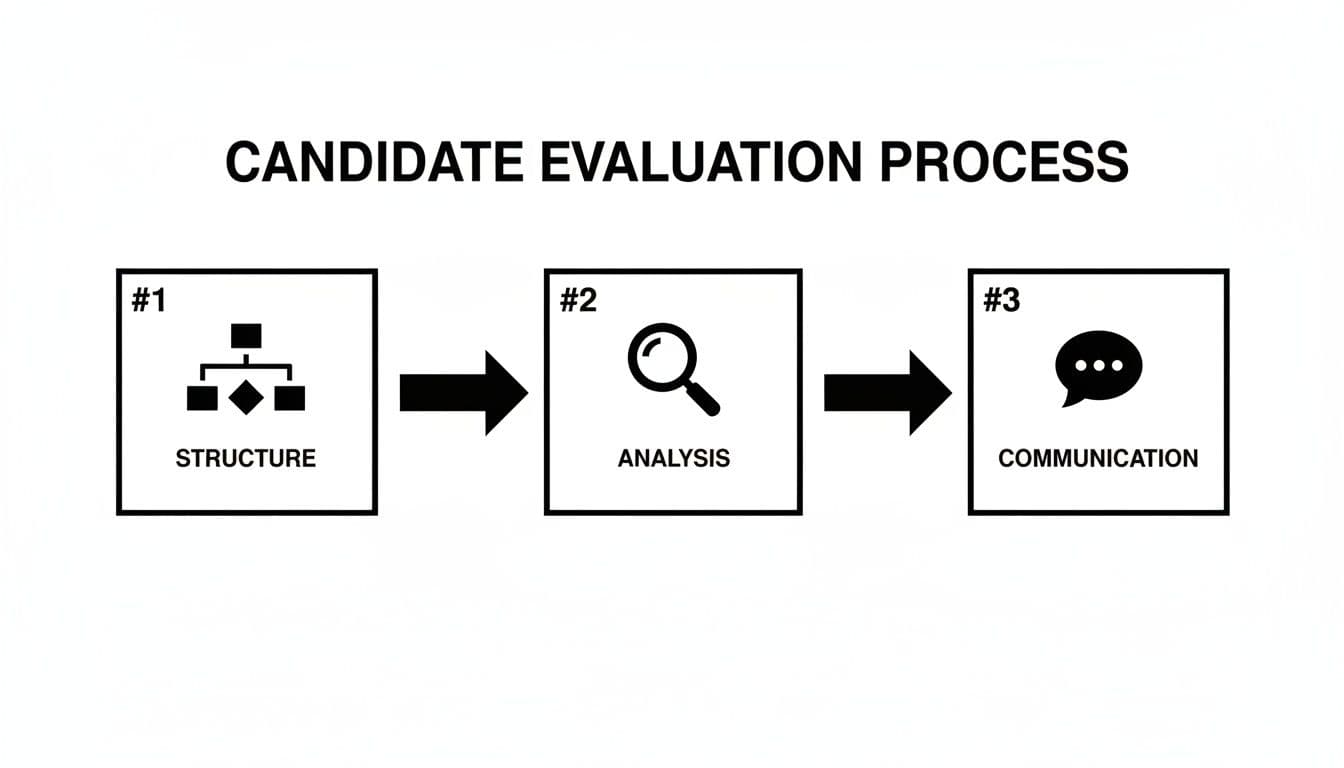
This shows how everything you do is being judged through the lens of your structure, your analytical rigor, and your ability to communicate it all clearly.
Stage 4: Synthesize And Recommend
After digging through the data—which might involve some quick back-of-the-envelope math—you should have a clear hypothesis about the root cause. The final step is to bring it all home with a strong, data-backed recommendation.
A great recommendation doesn’t just rehash the problem. It offers clear, actionable advice that looks forward. You need to deliver it with confidence, keep it concise, and tie it directly to the insights you just uncovered.
Sample Dialogue: "Based on our analysis, the primary driver of the 10% profit decline is a 15% drop in customer traffic, specifically in our urban locations. While costs have remained flat, this sharp revenue drop has hit our margins hard. I recommend a two-pronged solution. First, we should immediately launch a targeted customer loyalty program in these urban stores to win back repeat business. Second, we need to conduct a market survey to understand why customers are leaving—is it new competition, or have their preferences changed? As for next steps, I'd propose sizing the potential ROI of the loyalty program and scoping out the market survey."
This conclusion is powerful because it's structured, specific, and lays out a clear path forward. By following this blueprint, you can transform any case prompt into a masterclass on structured thinking. To see how you'd handle different scenarios, you can work through some sample cases for case interviews and put your skills to the test.
Building Your Case Interview Preparation Plan
Alright, so you know what a case interview is and you’ve seen one in action. Great start. But now comes the real work: building a smart, structured plan to get you ready for the big day.
Think of it like training for a marathon. You wouldn't just show up on race day hoping for the best. Acing a case interview takes consistent, focused practice across several key areas to build the mental muscle for structured thinking, quick math, and clear communication.
Mastering Frameworks Without Sounding Like a Robot
Frameworks are your best friend during case prep. They're the mental models that help you break down a huge, messy business problem into logical, bite-sized pieces. But here’s the classic mistake I see candidates make all the time: they treat frameworks like a script they have to recite from memory.
The real skill isn't memorizing frameworks—it's understanding the business logic behind them. An interviewer wants to see you adapt a framework to the problem, not force the problem into a memorized box.
This means you need to get to know the core components of the essential frameworks and, more importantly, develop an intuition for when to use each one.
Common Case Frameworks And When To Use Them
To get you started, here is a quick guide to some foundational frameworks and the types of business problems they are best suited to solve.
| Framework | Core Components | Best For Analyzing |
|---|---|---|
| Profitability | Profit = Revenue - Costs. Revenue breaks down into Price x Volume. Costs break down into Fixed + Variable. | Why a company's profits are tanking or how to get them back on track. |
| Market Entry | Market attractiveness, competitive landscape, company capabilities, and financial viability. | Whether a company should expand into a new country or launch a brand-new product. |
| Mergers & Acquisitions | Target company valuation, market attractiveness, potential synergies, and implementation risks. | If one company should buy another and what the strategic logic would be. |
| Porter's Five Forces | Threat of New Entrants, Bargaining Power of Buyers, Bargaining Power of Suppliers, Threat of Substitutes, Industry Rivalry. | Understanding the competitive pressure and overall health of an entire industry. |
Think of these as your starting lineup, not the whole game plan. Real mastery comes when you can mix and match these concepts to build a custom approach that perfectly fits the case in front of you.
Sharpening Your Case Math Skills
You don't need a Ph.D. in mathematics, but you absolutely have to be fast, accurate, and confident with business math. Nailing the calculations is what gives you credibility and buys you the time to figure out the "so what" behind the numbers, which is where the real insights are.
Start with some targeted drills to get your speed and accuracy up.
- Practice with large numbers: Get comfortable adding, subtracting, and dividing numbers with a lot of zeros. Think in millions and billions.
- Master percentages: You should be able to calculate percentage growth, market share, and margins without breaking a sweat.
- Break-even analysis: Know the formula (Fixed Costs / (Price - Variable Cost)) like the back of your hand and be ready to use it.
The goal is to make the math feel like second nature. This frees up your brainpower to focus on what the numbers actually mean for the business.
The Power of Consistent Practice
Reading about cases is one thing, but actually doing them is a completely different ballgame. Live practice is where the rubber meets the road.
Traditionally, this meant grabbing a friend and a case book. That's still a fantastic way to practice, but modern tools have opened up much more efficient options.
AI-driven platforms like Soreno now offer a serious leg up. Imagine practicing hundreds of cases whenever you want with an AI interviewer that’s been trained on real MBB methodologies. This lets you get in tons of reps without the headache of scheduling with a partner, and you get instant, objective feedback on everything from your case structure to your communication style. That kind of high-volume, focused practice can dramatically speed up your learning.
To get the most from your mock interviews and detailed feedback, it’s a smart move to use specialized transcription software for interviews to review your performance later.
By combining different methods—practice with peers, drills with AI, and your own self-study—you’ll build a well-rounded and incredibly effective prep plan. In this process, consistency is your most valuable asset.
Common Mistakes That Will Derail Your Interview
Knowing what to do in a case interview is important, but knowing what not to do can be the difference between an offer and a rejection. Even the sharpest candidates can fall into a few predictable traps when the pressure is on.
Learning to recognize these common pitfalls is one of the fastest ways to level up your performance. Once you see where others go wrong, you can build the self-awareness to stay on track.
The Dreaded Framework Dump
This is probably the most common mistake I see. A candidate gets a profitability prompt and immediately launches into a memorized script. It's what we call the "framework dump."
- What It Sounds Like: "Okay, this is a profitability case. I'll start by looking at revenues, breaking them into price and volume. Then I'll look at costs, splitting them into fixed and variable."
- Why It Fails: This tells the interviewer you've read a book, not that you can solve a problem. It’s generic, shows no real engagement with the specifics of the case, and comes across as lazy.
Instead, you need to build a structure that’s customized to the client's actual situation. Use the details from the prompt to create a bespoke framework. This subtle shift proves you have genuine business intuition.
Calculation Errors and Poor Math Hygiene
Everyone makes a math mistake now and then. The real issue isn't the error itself, but how you get there and how you recover. Rushing your calculations or just blurting out a number without explaining how you got it will tank your credibility.
Good "math hygiene" is non-negotiable. Be methodical. Talk the interviewer through your steps before you start doing the math. This gives them a roadmap of your thinking and even a chance to steer you back on course if you're about to go down a rabbit hole.
Pro Tip: Announce your plan before you calculate. Say something like, "To figure out the market size, I'm going to first estimate the total number of users, then multiply that by how often they'd buy the product, and finally by the average price."
This is called "signposting." It makes your quantitative work easy to follow and dramatically lowers the risk of a simple math error derailing your entire case.
Ignoring The Interviewer’s Hints
Think of your case interview as a conversation, not a presentation. A huge mistake is treating the interviewer as a passive observer. In reality, they're your partner in the problem-solving process and will often drop hints to guide you.
Ignoring these nudges is a massive red flag. It tells the firm you aren't coachable, which is a deal-breaker for a future consultant. If your interviewer asks, "Are you sure you've considered all the ways the company might be losing money?" they're throwing you a lifeline. Grab it.
Your ability to listen, adapt, and use feedback on the fly is a direct test of how you'll perform on a real project team.
The Weak or Indecisive Conclusion
You've spent the last 25 minutes breaking down the problem, and now it's time for the big finish: your recommendation. This is where so many candidates stumble, offering a vague, hesitant, or just plain weak summary. Just repeating your findings isn't good enough.
A powerful recommendation has to be:
- Actionable: Tell the client exactly what they should do next.
- Specific: Tie your advice directly to the data and insights you've uncovered.
- Forward-Looking: Briefly touch on potential risks and suggest next steps for further analysis.
Finishing with a confident, structured recommendation is your last chance to leave a great impression. It shows you have the poise and communication skills to be a trusted advisor.
Case Interview FAQs: Your Questions Answered
Even with the best preparation plan, you're bound to have questions pop up. Let's tackle some of the most common ones I hear from candidates.
How Much Time Do I Really Need to Prepare?
While there's no magic number, a solid benchmark is 30 to 50 hours of real, focused prep. I find it helpful to think about it in stages.
- First 10-15 hours: This is all about getting the fundamentals down. Learn the core frameworks, understand what interviewers are looking for, and get your mental math skills back up to speed.
- Next 20-30 hours: Now it’s time for live practice. This is the most critical phase where you'll do mock interviews with partners, friends, or AI tools to actually apply what you've learned.
- Final 5-10 hours: Use this last stretch to polish everything. Work on refining how you communicate your thoughts, manage the clock, and handle the pressure.
The key here is consistency. Spreading your prep out over a few weeks is way more effective than trying to cram it all in at the last minute.
Do I Need a Business Degree to Pass a Case Interview?
Absolutely not. In fact, some of the best candidates I've seen came from backgrounds in engineering, history, or science. Consulting firms actively recruit from a wide range of disciplines because they care far more about how you think than what specific business theories you know.
Your unique perspective is a strength, not a weakness. Just focus on showing them you can break down a problem logically and think in a structured way. If you can do that, you're on equal footing with any business major.
How Are Virtual Cases Different From In-Person Ones?
The core skills being tested—structured thinking, communication, and quantitative ability—are identical. The real difference is in the delivery.
In a virtual case, you have to over-communicate. Without the benefit of in-person body language, you need to be crystal clear and signpost every step of your thinking out loud.
You'll also be using a digital whiteboard instead of a notepad, so get comfortable with that format beforehand. Make sure your tech setup is rock-solid and practice looking into the camera to create a sense of connection. A strong virtual presence can make a huge difference.
Ready to stop memorizing frameworks and start mastering the case interview? Soreno provides unlimited, on-demand practice with an AI interviewer trained on MBB methodologies. Get instant, objective feedback on your structure, communication, and numeracy to accelerate your preparation. Try it free at https://soreno.ai.